Biomethane, H₂, CO₂… 2025 report by region
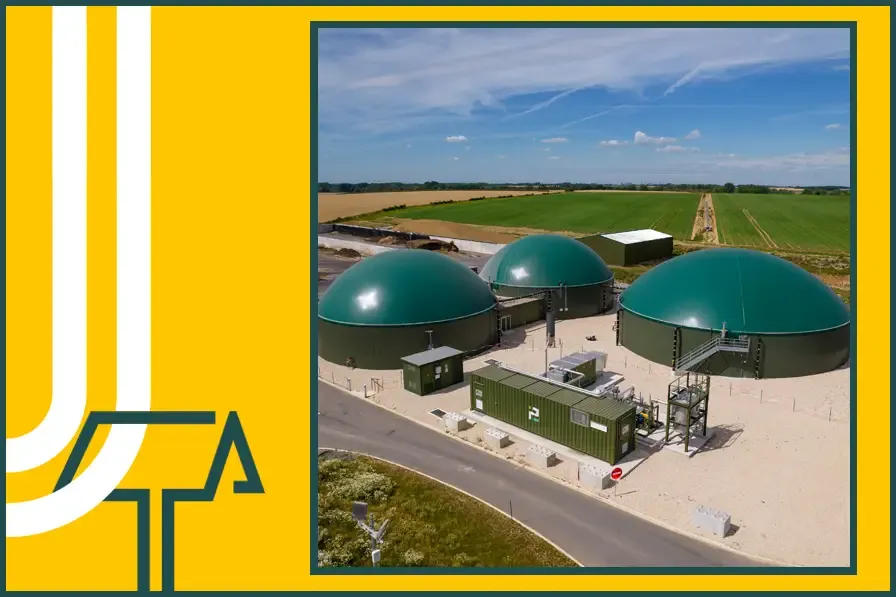
In 2025, the gas transition will move up a gear. Across France, biomethane production is on the rise, with 13.5 TWh fed into the gas network – a 17% increase year-on-year – whilst the first hydrogen and CO₂ networks are taking shape. Here’s what’s changing, region by region.
Quick access to each region
Quick access to the summaries by region, major inter-regional projects and detailed key figures and information (press releases and presentations).
North east regions
Val de Seine regions
Régions nord ouest
Rhône - méditerranée regions
Bourgogne-Franche-Comté
The 2025 gas transition ‘Tour de France’: key figures
2025 – a turning point?
Whilst gas consumption is falling, down to 350 TWh (-3%), driven in particular by economical use and energy efficiency, a different story is unfolding across the regions: that of a renewable energy source.
Biomethane production surged by 17% year-on-year to reach 13.5 TWh, with 802 anaerobic digestion plants in operation, compared with 731 at the end of 2024. Installed capacity even peaks at 15.5 TWh, putting France in the lead in Europe for biomethane production – a position that the Multi-Annual Energy Plan (Programmation pluriannuelle de l’énergie, or PPE3), published in February 2026, further reinforces with a target of 44 TWh by 2030.
Behind these national figures, each region is progressing at its own pace, in line with its strengths
Agricultural anaerobic digestion, bio-CNG transport, future hydrogen and CO₂ networks – NaTran is adapting its infrastructure wherever the transition is gathering pace. We take a tour around the regions of France.
Grand Est regions
Grand Est: a leader in anaerobic digestion
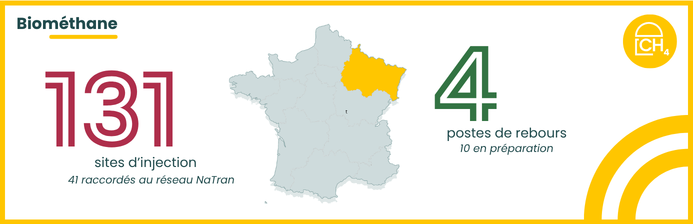
Its 131 injection sites, 41 of which are connected to the NaTran network, have a capacity of 3.0 TWh per year, up 5% year-on-year, representing 19% of national production. Biomethane now accounts for 5.7% of regional consumption, compared with 5.2% in 2024, well above the national average (4.5%). Four reverse flow stations* are in operation and a further ten are in the pipeline.
*Reverse flow station: a small compressor station that activates automatically to capture excess biomethane produced in a given area and redirect it via the transmission network.
In the hydrogen sector, the region is home to a number of major cross-border projects, including mosaHYc, HY4Link, RHYN et HY-FEN, which are forming an H₂ network connecting France, Germany, Belgium and Luxembourg.
Respondents from the Grand Est region showed major interest in the Call for Expressions of Interest (CEI) for a future 1,000 km inter-regional CO₂ transport network, which will connect Normandy, Île-de-France, Hauts-de-France and the Grand Est regions.
Hauts-de-France region
Hauts-de-France, the industrial powerhouse, is looking into CO₂ capture and storage
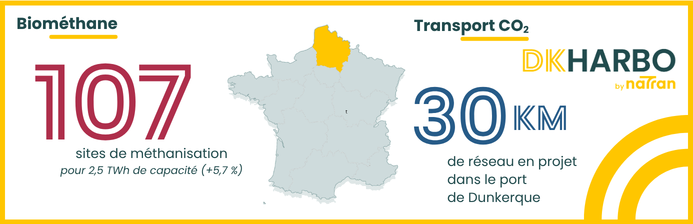
The Hauts-de-France region has 107 anaerobic digestion plants with a capacity of 2.5 TWh (+5.7%), representing 16% of the national total. Here, biomethane accounts for 5.3% of consumption, compared with 5.0% a year earlier.
Regional consumption remains stable at 47.5 TWh, performing better than the national average thanks to a strong industrial base.
Above all, the region is establishing itself in the field of CO₂ transport through DKHARBO, a 30-kilometre network in the port of Dunkirk (4 million tonnes per year, €7.7 million in EU grants), connected to the North Sea storage facility operated by its Norwegian partner, Equinor.
As a follow-on, a new 1,000-km inter-regional CO₂ network project is being developed.
Île-de-France region
Île-de-France: a showcase for mobility and a new frontier for CO₂
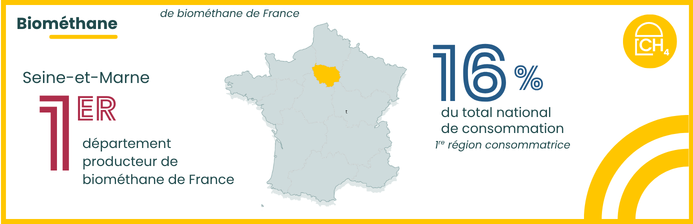
As the region with the highest consumption (57.3 TWh, 16% of the national total), Île-de-France cementing its role as a showcase.
Seine-et-Marne remains France’s leading producer of biomethane, with 1,042 GWh, representing nearly 48% of its own consumption. The region has 63 anaerobic digestion plants (+5%) and 86 projects under consideration.
In terms of transport, 1.4 TWh of CNG and bio-CNG was consumed – enough to power around 4,000 buses – via 53 refuelling points. The Marchémoret (Seine-et-Marne) reverse flow station*, the largest of its kind in France, handled 174 GWh of biomethane in 2025.
*Reverse flow station: a small compressor station that activates automatically to capture excess biomethane produced in a given area and redirect it via the transmission network.
The call for expressions of interest (CEI) for an inter-regional CO₂ transport network project confirmed a demand of 2.3 million tonnes per year in the region.
NaTran has compiled 17 responses from stakeholders across the region covering the entire CO2 value chain:
- 12 industrial operators (industrial sites, waste managers, etc.);
- 5 anaerobic digestion sites wishing to utilise their biogenic CO2.
Normandie region
Normandie: strongest momentum in methanization
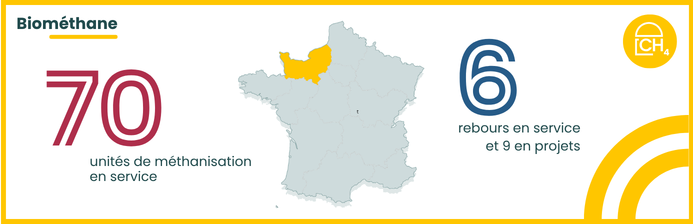
Normandy has recorded one of the most impressive gains, with a biomethane capacity of 1.4 TWh (+16%) from 70 units and, notably, 181 projects under development—a 33% increase in a single year.
To accommodate this local production, NaTran is rolling out an unparalleled "reverse-flow" program*: six units are currently in operation, six are under construction for 2026, and nine are in the planning stage—totaling 21 facilities and an eventual investment of nearly €60 million.
The region is also spearheading the future 1,000 km inter-regional CO₂ transport network, which will link Normandy, Île-de-France, Hauts-de-France, and Grand Est.
*Reverse-flow station: a small compression station that activates automatically to capture excess biomethane produced in a specific area and redirect it into the transport network.
Bretagne region
Brittany, the leader in biomethane consumption
Brittany retains its leading position nationally in terms of the share of biomethane in regional consumption, which stands at 7%.
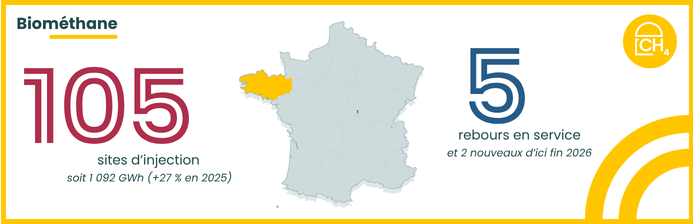
Its 105 sites (+4%) generated 1,092 GWh, up 27% year-on-year, driven by strong agricultural activity. With 106 projects in the pipeline representing 1.4 TWh, the region is set to more than double its production in the short term and aim for biomethane to account for over 15% of its consumption.
NaTran is speeding up the deployment of reverse flow* here, with a fifth station commissioned in Javené (Ille-et-Vilaine) in March 2026, and two more to follow, in Morlaix (Finistère) and Loudéac (Côtes-d'Armor) before the end of the year.
*Reverse flow station: a small compressor station that activates automatically to capture excess biomethane produced in a given area and redirect it via the transmission network.
Centre-Val de Loire region
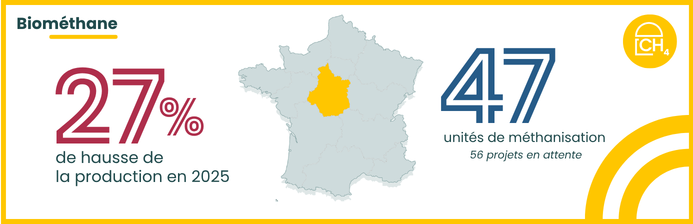
Centre-Val de Loire: the most spectacular growth
In the Centre-Val de Loire region, biomethane production jumped by 27% to 0.7 TWh, generated at 47 sites (+4%) and accounting for 6% of regional consumption.
With 56 projects in the pipeline representing 1.5 TWh, the region could triple its production and increase the share of biomethane in its consumption to over 20%. The 6 Fermes site in Girolles (Loiret), which is due to be connected to the NaTran grid in 2025, illustrates this expansion, whilst the reverse flow station in Gien (Loiret) brings the number of operational stations to four, with a further twelve under consideration.
Auvergne-Rhône-Alpes region
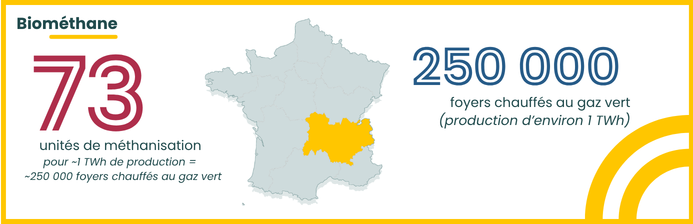
Auvergne-Rhône-Alpes: a clear ambition for 2030
Its 73 anaerobic digestion plants (+7 in 2025) produce around 1 TWh, equivalent to heating 250,000 households with green gas and avoiding 230,000 tonnes of CO₂ emissions, with a target of 180 units and 5 TWh set for 2030.
The region is also preparing for hydrogen, through the European IMAGHyNE project and a proposed 40-km hydrogen pipeline between the Vallée de la Chimie and Lyon-Saint-Exupéry Airport,, a future link in the HY-FEN chain, 286 km of which will run through the region.
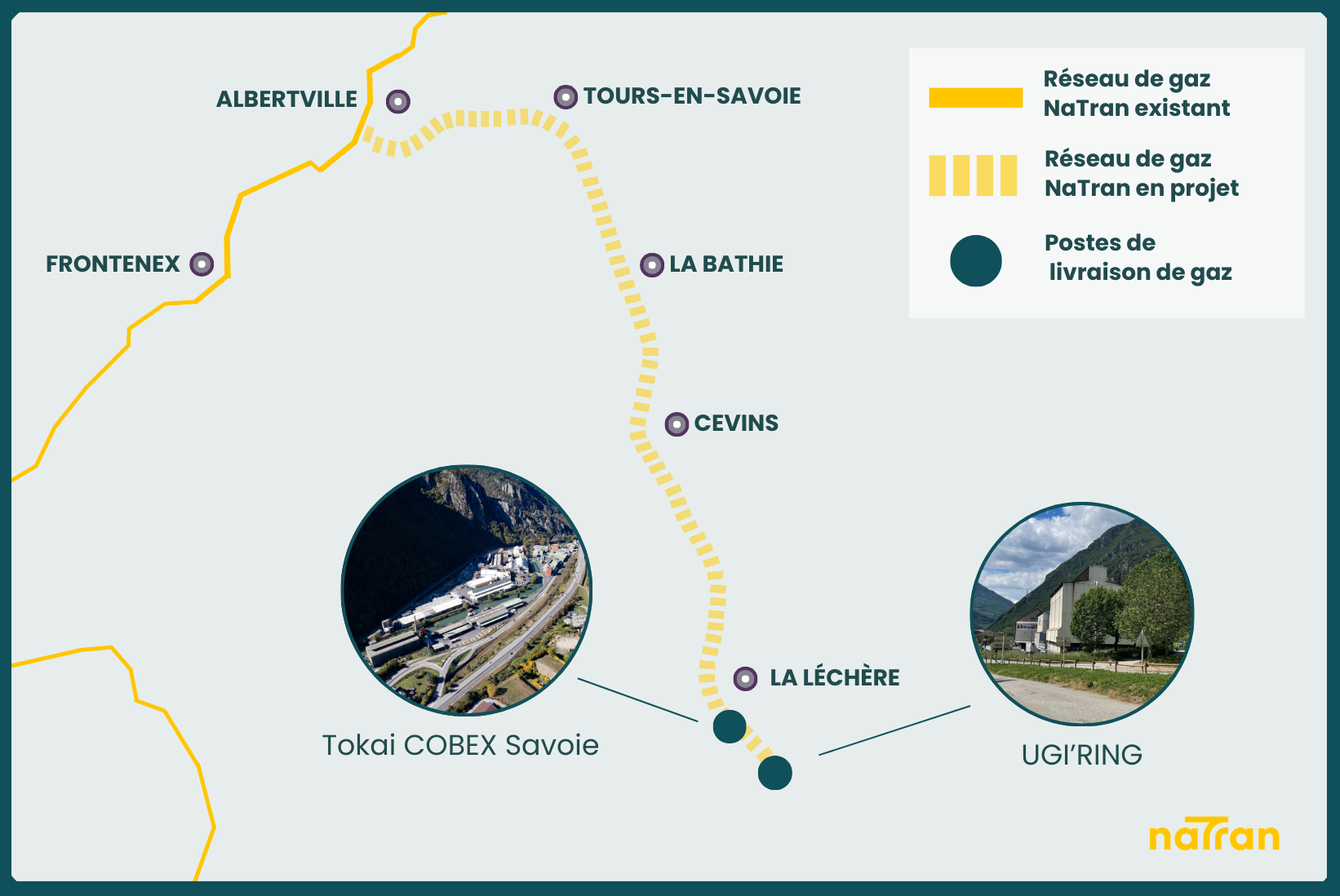
In the Tarentaise region, an agreement signed at the end of 2025 provides for a 25-kilometre pipeline that is technically compatible with hydrogen, with a view to supporting local industrial competitiveness.
NaTran is investing 15 million euros in this 25-kilometre stretch of infrastructure between Albertville and La Léchère. Designed for transporting natural gas and biomethane, it will eventually be technically compatible with hydrogen.
Map of the project
Bourgogne-Franche-Comté region
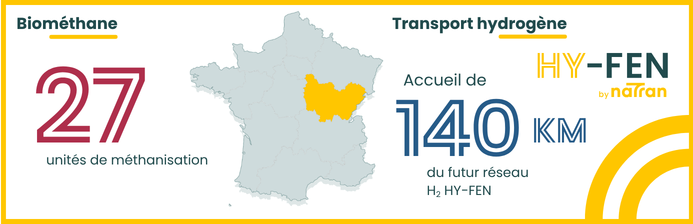
Bourgogne-Franche-Comté: the challenge of agricultural anaerobic digestion
Bourgogne-Franche-Comté is still on course to achieve 1 TWh of biogas, with 27 plants (an increase of one in 2025) having fed 0.75 TWh into the grid in 2025 and a target of 3 TWh by 2030. The region is capitalising on its close ties with the agricultural sector through the “metha’salons” organised in collaboration with GRDF and a new partnership forged with the association of farmers operating anaerobic digestion plants in Bourgogne-Franche-Comté (AAMF BFC).
Twelve CNG stations already serve the region, including in Sens (Yonne), which opened in 2025. The region will also be home to 140 km of the future HY-FEN hydrogen network.
Provence-Alpes-Côte d’Azur region
Provence-Alpes-Côte d’Azur: hydrogen for industry
In Provence-Alpes-Côte d’Azur, the transition is centred primarily on industry.
The region, which accounts for 7% of national gas consumption (24.4 TWh, down 10.4% year-on-year), has seen refining and petrochemicals decline by 15%, the first sign of a decarbonisation process getting under way in the Fos-sur-Mer industrial and port area (Bouches-du-Rhône).
Anaerobic digestion remains limited here, held back by a less favourable location, with 100 GWh injected into the grid in 2025 against a target of 2 TWh in 2030, which NaTran is preparing for by examining an initial reverse flow project in Istres (Bouches-du-Rhône), expected in 2028.
It is hydrogen, in particular, that is putting the region on the map.
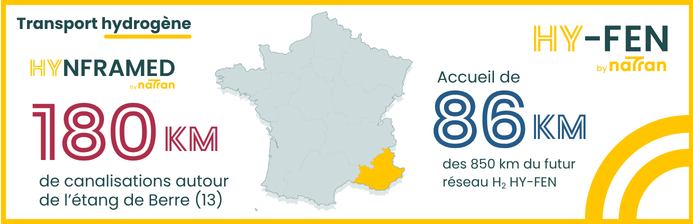
Le HYnframed project involves laying 180 km of pipelines around the Étang de Berre, connected to the Manosque storage facility, with the aim of preventing the emission of 4 million tonnes of CO₂ by 2040.
The region will also be home to 86 of the 850 km of the future HY-FEN backbone and the BarMar offshore section, which will connect Marseille to Barcelona as part of the European H2med corridor. With a network spanning 1,464 km and €31 million invested by 2025, NaTran is rolling out the infrastructure for an industry-led transition in the region
When regions work together: major inter-regional projects
The transition does not stop at administrative boundaries
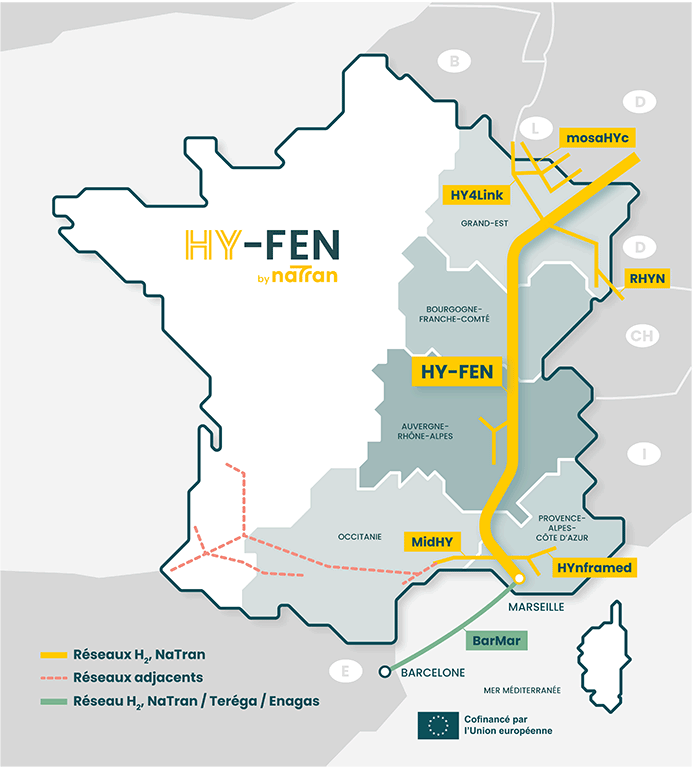
When it comes to hydrogen, HY-FEN is shaping the future of France’s hydrogen backbone.
Stretching 850 km, it will pass through five regions (Auvergne-Rhône-Alpes, Bourgogne-Franche-Comté, Grand Est, Occitanie and Provence-Alpes-Côte d’Azur), which signed a joint declaration of support in Lyon on 1 July 2025. Recognised as a project of common interest¹ by the European Union and supported by €15 million in EU funding, HY-FEN will be the subject of a preliminary consultation in autumn 2026, with a view to entering into service in 2032.
1 Project of Common Interest (PCI): an EU status entitling the project to fast-track authorisation procedures and EU funding.
>>> Find out more about HY-FEN
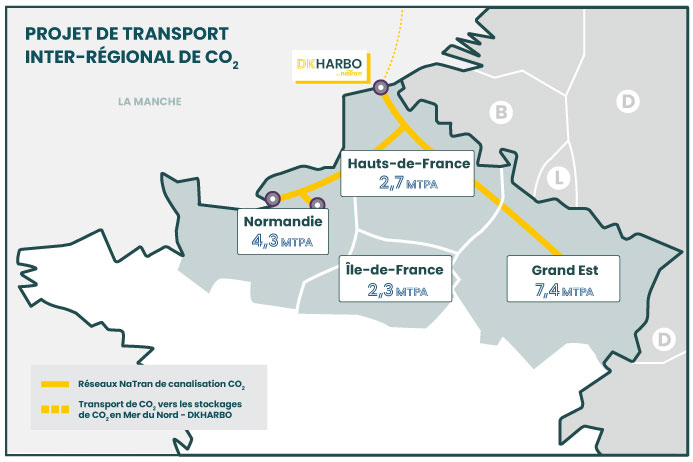
In terms of support for carbon capture, NaTran operates an inter-regional CO₂ transport pipeline of around 1,000 km linking the Grand Est, Hauts-de-France, Normandie and Île-de-France regions. The call for expressions of interest, which closed in early 2026, was a resounding success, with more than 200 stakeholders involved and a potential reduction of 16.7 million tonnes of CO₂ emissions per year – the equivalent of 27% of emissions from the French manufacturing sector. Linked to the DKHARBO project in Dunkirk and to storage facilities in the North Sea, this infrastructure has even attracted investors from Luxembourg, Germany and Switzerland, giving it a cross-border dimension.
>>> Results of the inter-regional CO₂ transport project
Plan of the inter-regional CO2 transport project, with responses to the CEI by region
Top 5 regional gas balances
- Île-de-France: 57.3 (57.6 in 2024)
- Grand Est: 52.2 (52.9 in 2024)
- Hauts-de-France: 47.5 (47.7 in 2024)
- Normandie: 35.7 (38.2 in 2024)
- Auvergne-Rhône-Alpes: 37.0 (38.0 in 2024)
- Grand Est: 3.0 (2.7 in 2024)
- Hauts-de-France: 2.5 (2.3 in 2024)
- Normandie: 1.4 (1.2 in 2024)
- Île-de-France: 1.3 (1.2 in 2024)
- Nouvelle-Aquitaine: 2025 figure to come (1.1 in 2024)
- Bretagne: 7.0 % (5.9 % in 2024)
- Centre-Val de Loire: 6.0 % (2024 data not disclosed)
- Grand Est: 5.7 % (5.2 % in 2024)
- Hauts-de-France: 5.3 % (5.0 % in 2024)
- Nouvelle-Aquitaine: chiffre 2025 à venir (4.8 % en 2024)