Guaranteeing the continuity of gas transmission

NaTran operates a strategic network that plays a key role in energy security. It must therefore be able to handle increases in the quantity of gas transported during cold periods, as well as during exceptional weather conditions.
A public service role
Public service and the common good are core values for NaTran.
The French Energy Code sets out public services obligations that apply to some stakeholders in the natural gas sector. These obligations are supplemented by the provisions of the Multiannual Energy Programme, and strengthened by the public service contract signed between NaTran and the State. Contributing to energy security of supply and Guaranteeing the continuity of gas transmission are two of these obligations. Others include those linked to the security of the network and its energy efficiency and to the recovery of biogas.
Continuity of gas transmission: requirements
The obligations of the Energy Code and NaTran's actions
Article R.121-8 of the French Energy Code requires transport network operators to guarantee the transportation of gas, even in extreme weather conditions. In practice, NaTran implements numerous measures to meet this obligation on a daily basis, including:
- Ensuring that the infrastructures (pipelines, compressor stations, interconnections and delivery stations) are sufficient to support the security of supply in France and in Europe
- Day-to-day management of network balancing and gas flows, while respecting customers’ transportation requirements
- Coordinating maintenance operations for its network and with the operators of adjacent gas infrastructures
- Predicting how the network will function under any potential stress
- Guaranteeing maintenance and monitoring of its infrastructures.
Titre
Current projects
Travaux sur l’artère du Rhône
Développement industriel de la vallée de la Tarentaise
L gas to H gas conversion project
Notable innovations
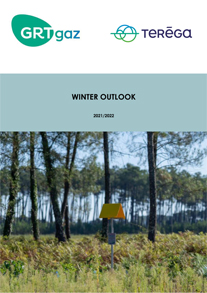
To improve energy security of supply, NaTran designs and implements certain innovations on an ongoing basis. Several major advances have been made in recent years. For instance, for several years GRTgaz has published a Winter Outlook to inform the market about potential stresses during the upcoming winter. This tool is now produced in common with Teréga.
The implementation of a single trading zone (Trading Region France – TRF) in October 2018 improved France’s energy security by increasing the attractiveness of the French gas market and supporting the creation of new tools. These include the ‘localised Spread’ – a market mechanism allowing shippers to be consulted to help de-bottlenecking the network by buying and selling gas at a local level, upstream and downstream of the bottleneck.
Underground storage facilities, in particular, are indispensable for meeting consumption needs during the winter.
Three kinds of sources of supply
Gas pipelines, LNG carriers, storage facilities: the pillars of security of supply
To guarantee the energy security of the natural gas supply, including during periods of extremely cold weather, the entire gas system relies of diversified sources of supply:
- Pipelines
- LNG terminals
- Underground storages
It is also supported by one of Europe’s most heavily interconnected networks.
The continuity of gas transmission is ensured on a daily basis by a national dispatching unitand four regional monitoring centres. Their round-the-clock service guarantees the following operations:
- Managing gas flows
- Remote operation of the main bodies making up the transport network
- Remote monitoring of the transport network, the stations and the delivery points
- Gas quality control
>>> How does NaTran ensure the security and availability of its network on a day-to-day basis?
Gas consumption overview in France for winter
Updated every week, the dashboard provides an inventory of the gas system in the context of energy crisis and the Government’s energy efficiency plan.
Publications
Questions and answers about continuity of supply
NaTran ensures that its infrastructure—gas pipelines, compressor stations, and interconnections—is properly sized to maintain a safe and consistent supply of gas, even during periods of high demand. The network is monitored 24/7 by regional centers.
This national program aims to convert the network in northern France, which is supplied with low-calorific B gas, to accommodate higher-energy H gas. Running until 2029, it guarantees security of supply for 1.3 million customers.
NaTran develops several tools, such as Winter Outlook, to anticipate network constraints and enhance reliability. The single TRF zone and new market mechanisms improve the fluidity of the French gas network.