Results of the inter-regional CO₂ transport project
The call for interest (AMI) launched by NaTran for the inter-regional CO₂ transport project in the Hauts-de-France, Grand Est, Normandy and Ile-de-France regions has been a success.
Project description
NaTran’s inter-regional CO2 transport project aims to transport the CO2 captured by industrial companies, waste managers, and operators of biomass heating plants, incinerators, or methanisation facilities via underground pipelines to CO2 utilisation sites and the Grand Port Maritime de Dunkerque.
There, thanks to NaTran's DKHARBO project and au partenariat avec Equinor (a Norwegian public company, a pioneer in CO2 storage in Europe) and its CO2 Highway Europe project, the CO2 can be transported by underwater pipeline to permanent geological storage sites in the North Sea, in Norway.
Results of the Call for Interest
16.7 million tonnes of CO2 identified per year, equivalent to 27% of French manufacturing industry emissions and 4.5% of French CO2 emissions.
More than 200 responses from stakeholders covering the entire CO2 value chain:
- Nearly 90 industrial companies (industrial sites, waste managers, biomass heating plant operators…);
- More than 100 methanisation sites wishing to utilise their biogenic CO2;
- 5 volume aggregators which, by pooling injection points, make it possible to integrate small or isolated emitters and to optimise the transport of CO2 on a regional scale;
- A sovereign storage project in the Paris Basin.
The results confirm a significant availability of biogenic1 CO2, amounting to 6.4 million tonnes per year. At the same time, significant needs for utilisation projects for this CO2 have also been identified, totalling 2 million tonnes per year.
Results of the Call for Interest by Region
37 responses from stakeholders:
- 17 industrial companies (industrial sites, waste managers, operators of biomass heating plants or incinerators, etc.);
- 20 methanisation sites wishing to utilise their biogenic CO2*;
Outlet projects for CO2: 1 export terminal located in the industrial port zone and 4 biogenic CO2 utilisation projects;
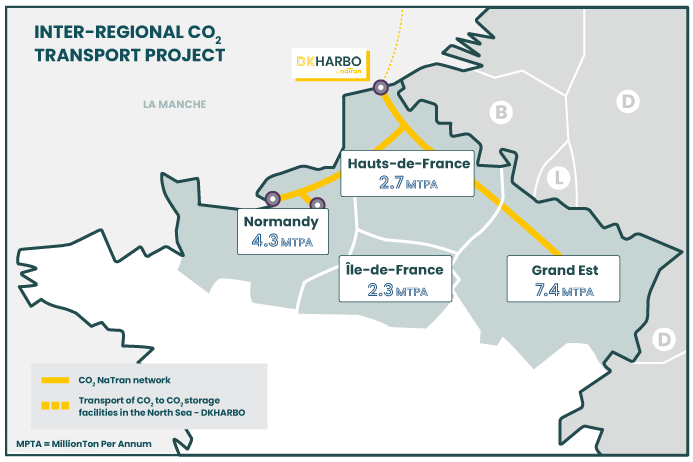
The total transport needs identified in Normandie amount to 4.3 million tonnes de CO2 per year (including 1.5 million tonnes of biogenic CO2*). The volume of CO2 utilised represents 1.1 million tonnes per year.
*Biogenic CO₂ : CO2 from biomass, i.e. organic matter of recent and renewable origin (plants, organic waste, agricultural or forestry residues). Unlike CO2 of fossil origin, CO2 is part of the natural carbon cycle: it corresponds to carbon previously captured by plants during their growth. As such, it has a neutral impact on the climate when it is re-emitted or utilised.
45 responses from stakeholders covering the entire value chain of CO2 :
- 18 industrial companies (e.g. in the chemical/petrochemical or cement/lime sectors, waste treatment associations, operators of energy utilisation units linked to these sites, or operators of biomass heating plants) ;
- 27 methanisation sites wishing to utilise their biogenic CO2.
Outlet projects for CO2: 1 export terminal located in the industrial port zone and 1 biogenic CO2 utilisation project;
The total transport needs identified for the Hauts-de-France region amount to 2.7 million tonnes of CO2 per year (including 1.1 million tonnes of biogenic CO2). The volumes of CO2 for the utilisation of CO2 represent 0.3 million tonnes per year.
88 responses from stakeholders covering the entire CO2 value chain:
- 32 industrial companies (e.g. in the chemicals/petrochemicals or cement/lime sectors), trade unions for waste treatment, operators of energy utilisation units linked to these sites, or operators of biomass heating plants;
- 56 methanisation sites wishing to utilise their biogenic CO2;
Outlet projects for CO2: 3 biogenic CO2 utilisation projects.
The total transport needs identified in the Grand Est region amounts to 7.4 million tonnes of CO2 per year (including 2.3 million tonnes of biogenic CO2). The volumes of CO2 for the utilisation of CO2 represent 0.6 million tonnes per year.
17 responses from stakeholders:
- 12 industrial (industrial sites, waste managers…) ;
- 5 methanisation sites wishing to utilise their biogenic CO2;
The total transport needs identified in Île-de-France amount to 2.3 millions de tonnes de CO2 per year (including 1.4 million tonnes of biogenic CO2).
Stages of the inter-regional CO₂ transport project
First stages:
- Summer 2025 : pre-feasibility study of the CO2 transport infrastructure carried out by NaTran. Basis: market potential by region (ZIBaC initiative launched by ADEME in conjunction with industry associations), CO2 export projects [Dunkerque and Le Havre], sustainable fuel production projects (eSAF and e-methanol), with biogenic CO2 utilisation.
- December 2025 – February 2026 : Call for interest (AMI)
- April 2026 : Communication of the results of the call for interest
- Spring 2026 : launch of a technical feasibility study, based on the results of the call for Interest, in conjunction with customer commitments and financing.
Next stages:
- 2026-2027: feasibility studies by phase
- 2028: launch of basic studies for the first phase
- 1st commissioning targeted for 2034 / 2035
Network sizing:
- Length: up to 1000 km of network
- Transport capacity: to be confirmed during the feasibility study
Schematic layout of the inter-regional CO2 transport project, with responses to the call for interest by region