NaTran in brief
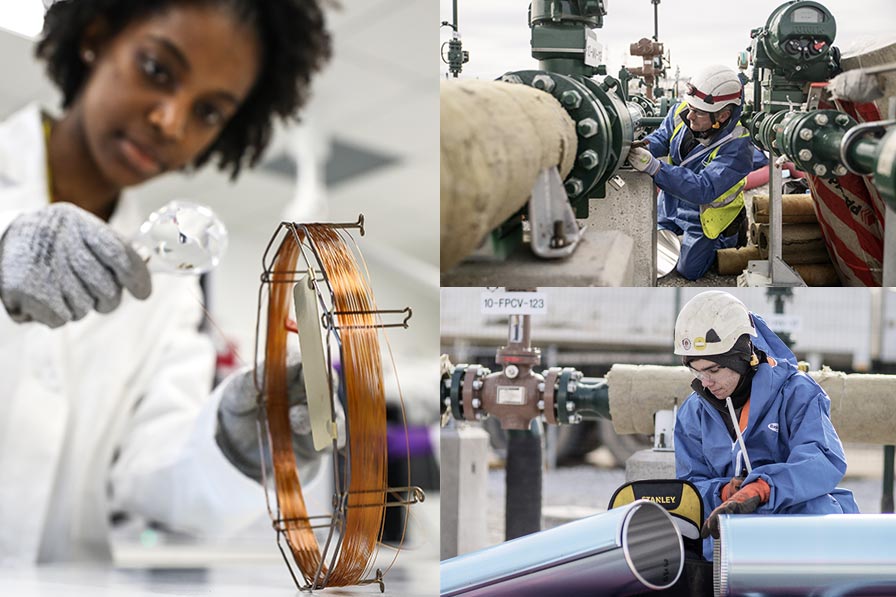
As a key player in the gas infrastructure sector, NaTran carries out a vital role every day in ensuring the smooth operation of the French and European energy systems. Operating within a regulated framework and in the public interest, the company ensures the security of gas supplies, connects regions to major energy infrastructure, and is preparing its network for the integration of renewable and low-carbon gases.
NaTran's activities in just a few clicks
Quick access to the page's various sections: presence in France and Europe, our missions and documentary resources...
Objectives and commitments
Educational resources
Our commitments to achieving carbon neutrality by 2050
Why is the NaTran network strategic for the regions?
With over 32,500 km of high-pressure pipelines in France, it is one of the most extensive gas transmission networks in Europe. This network is connected to the gas infrastructure of Norway, Belgium, Germany, Switzerland, Italy (via Switzerland) and Spain (via the Teréga network).
It is also connected to 4 underground storage facilities and 4 LNG terminals located along the French coastline. Thanks to these connections, we can ensure access to a diverse range of gas sources and help to safeguard the security of transmission and supply.
NaTran is a key player in the gas infrastructure sector in France and Europe. On behalf of the community, our company guarantees the continuity of the transport, whilst gradually adapting its network to changes in the energy system. Our work is carried out within a regulated, long-term framework. We act in the public interest, for the safety of transport and the balanced development of territories.
Through our subsidiaries Elengy, the leading provider of LNG terminal services in Europe, and NaTran Deutschland, the operator of the MEGAL network in Germany, we play a key role in the European gas infrastructure sector. This presence enhances the security of transmission and supply, as well as energy solidarity between regions.
This map and the information it contains are for guidance only and do not authorise the carrying out of works in the vicinity of the NaTran pipeline network, nor do they exempt the user from compliance with the provisions of the French Environment Code, Articles L.554-1 to L.554-5 and R.554-1 to R.554-38.
What are NaTran’s objectives, commitments and areas of focus? Our public service mission
NaTran ensures the uninterrupted supply of natural gas and the safety of its infrastructure. We supply energy to distribution networks, industry and the electricity generation sector, operating within a regulated and demanding framework, in the public interest.
NaTran carries out its work within a rigorous governance framework based on ethics, regulatory compliance and transparency. Our ethics whistleblowing system enables any stakeholder to report a breach of our policy with a single click, whilst ensuring confidentiality.
NaTran follows a CSR approach that underpins all its environmental, social and community commitments. It gives concrete expression to the company’s purpose and provides a framework for its long-term activities.
s a gas transmission operator fulfilling a public service mission, NaTran is committed to achieving carbon neutrality by 2050, in line with the climate goals of France and the European Union.
NaTran works closely with the regions, in partnership with the local communities, the industry and the agricultural stakeholders.
The network helps to promote local produce, support the circular economy and meet regional energy needs.
Our company draws on its NaTran R&I research and innovation centre to develop practical solutions that enhance industrial safety, improve network performance and facilitate the integration of renewable and low-carbon gases. Through open and collaborative innovation, NaTran works with partners from industry, academia and the innovation sector to support the development of biomethane, hydrogen and CO2 transport.
This approach is also underpinned by ongoing investment in training and skills development, with a view to equipping people with the skills and expertise required for the energy transition et aux infrastructures de demain, au service des territoires et de l’intérêt général.
NaTran is adapting its transmission infrastructure to accommodate renewable and low-carbon gases on its network.
In preparation for new gas production to be transported over the network, we are working to develop the infrastructure required for renewable and low-carbon gases and supporting the associated sectors.
The three pillars of our hydrogen development strategy are:
- Develop open-access hydrogen transport networks in France’s main industrial regions.
- Gradually expand coverage across the entire country, ensuring continuity of supply by interconnecting industrial regions and linking production and consumption zones with hydrogen storage solutions.
- Foster the development of European interconnectors by coordinating and leading cross-border initiatives and the H2med European corridor project.
Nous participons à l’essor des projets de captage et de transport de CO2 dans les principales zones émettrices. Ces solutions de décarbonation sont complémentaires au développement des gaz renouvelables et bas-carbone.
Key documents to get to know us better

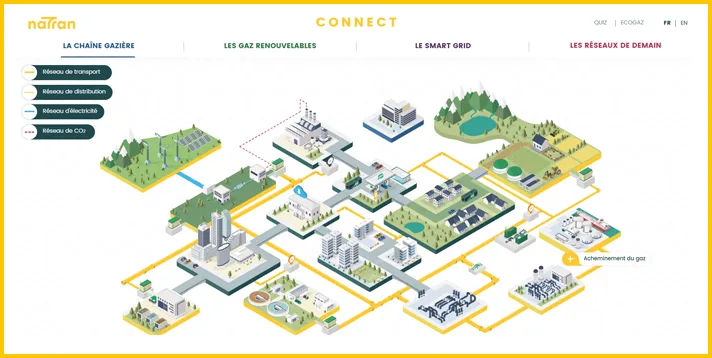
CONNECT: an educational tool
Connect presents gas transport and distribution networks as well as sectors related to renewable gases and the networks of tomorrow.
Questions and answers
What makes NaTran’s infrastructure unique is its adaptability. We are transforming an existing strategic gas network to bring it into line with European climate targets, without compromising on safety or service continuity.
Originally designed to fulfil a vital public service role, our infrastructure now ensures the safe transport of gas whilst gradually incorporating new fuels: biomethane, hydrogen, and, in the future, CO2.
And with over 32,500 km of interconnected pipelines across Europe, our network serves as a robust and resilient tool for energy solidarity between regions, designed with a long-term perspective in mind.
The energy transition represents a profound transformation not only of infrastructure but also of the industries involved. Innovation means adapting our networks to new gases and continuously improving safety and environmental performance.
Accepting new forms of energy means preparing the men and women at NaTran for technological, industrial and digital changes. Therefore this innovation only makes sense if it is accompanied by skills development. The energy transition is, above all, a human and collective endeavour.
The main challenge will be to balance security of supply, carbon neutrality and local roots. Indeed, infrastructure will need to remain reliable and available at all times, whilst integrating increasingly diverse and, in some cases, more intermittent energy flows, all within an increasingly interconnected European framework.
This challenge is also a societal one: it involves engaging with the regions, demonstrating the value of infrastructure, and developing fair and balanced transition pathways. For NaTran, this means acting responsibly, transparently and proactively, whilst remaining true to its public service mission and its raison d’être: to pave the way for a secure, affordable and climate-neutral energy future.