


RHYN
Last updated: January 23, 2026
Description of project
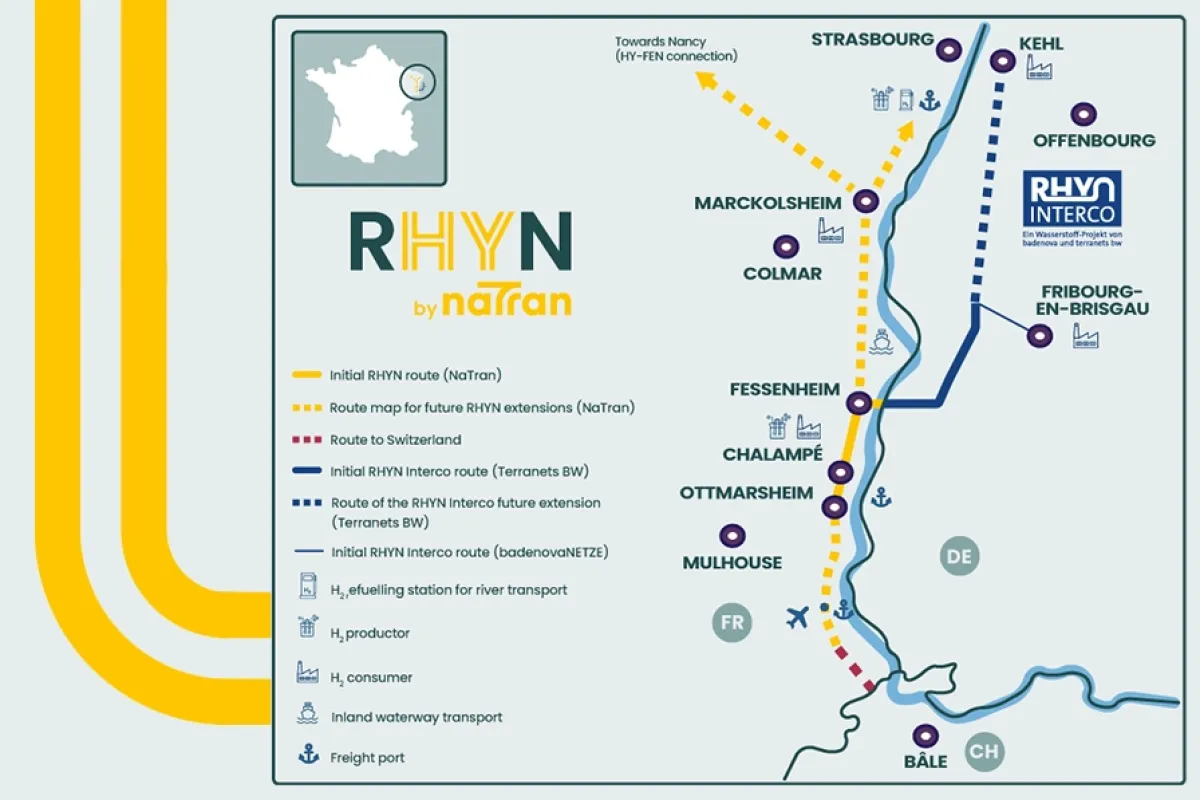
RHYN is a 100% hydrogen pipeline project in the Upper Rhine Trinational Metropolitan Region. Its aim is to connect consumption to the production of renewable and low-carbon hydrogen in order to ensure security of supply for all market players in the territory.
RHYN represents approximately 100 km of pipelines, 25% of which have been converted. Its capacity will be 190,000 tons of hydrogen per year, the equivalent of approximately 1,400 MW of electrolysis. Commissioning is scheduled for 2030.
The gas network operators NaTran, terranets bw and badenovaNETZE are working together on the hydrogen interconnection between Southern Alsace and South-West Baden-Württemberg. The RHYn and RHYn Interco (German part of the project) projects are labelled Projects of Common Interest by the European Commission and are recipients of a grant under the Connecting Europe Facility.
NaTran also wishes to expand its network to Switzerland in collaboration with Gasverbund Mitteland (GVM) and Industrielle Werke Basel (IWB).
Hydrogen uses
High potential for industrial demand The Chalampé – Ottmarsheim industrial zone is now the 2nd largest hub in terms of hydrogen consumption in France. Its production of 2.4 TWh of fossil hydrogen per year is the equivalent of 15% of French production by SMR. The companies present in the zone have significant decarbonization ambitions that can be achieved by eventually replacing old hydrogen sources with electrolysis and by developing new uses. High-potential sectors include: chemistry, glass manufacturing, semiconductors, transport equipment and machinery, as well as the agri-food sector.
First stages
- 05/2022: Project integrated into the ZIBaC call for projects
- 09/2023-11/2023: Call for Expression of Interest
- 06/2024 - 02/2025: Feasibility study
Next stages
- 04/2025 – 09/2027: Basic studies
- 10/2027 – 09/2029: Detailed study
- 12/2030: Commissioning
Grid sizing
- Diameter: Mainly 400 mm.
- Length: Approximately 100 km.
- Capacity: 20 GWh/day.
Project’s environmental impact
The pipeline will have the capacity to transport 190,000 tonnes of renewable or low-carbon hydrogen per year, which will thus be integrated into the French and European energy system. This is the equivalent of the production of 1,400 MW of electrolysis and could avert up to 2 million tonnes of CO2 emissions per year.
Publications
Your contacts
Project Director
Communication and Press Relations
Contact us by email: project email / Sylvie Antonini