


Our corporate social responsibility (CSR)
Approved by the Board of Directors in 2025, NaTran’s CSR policy sets out the framework for the implementation of its purpose up to 2030, through the NaTran2030 corporate strategy.
CSR policy and environmental commitments
Quick access to the page's various sections, structured into two main parts: our CSR policy and our environmental commitments.
Our CSR policy
Building our CSR approach
Activities and circular economy
How does NaTran's CSR policy translate into concrete commitments?
NaTran's CSR policy is based on 4 key areas of focus, broken down into 13 commitments, which stem directly from our raison d'être.
- A1 - Contribute to national security of supply
- A2 - Promote affordable and sustainable access to energy
- A3 - Ensure the integrated global safety of our activities
- A4 - Carry out our missions and activities ethically
- B1 - Decarbonise the gas chain and strengthen climate resilience
- B2 - Reduce our impact and help to restore biodiversity
- B3 - Use resources sparingly and develop the circular economy
- C1 - Work with local players and industries to make the energy transition a reality
- C2 - Meet our customers' energy needs and support the decarbonisation of their energy use
- C3 - Cooperate with our suppliers to build a value chain that respects planetary boundaries
- D1 - Promote a safe and healthy working environment for our employees and contractors
- D2 - Develop the employability and commitment of our employees
- D3 - Promote inclusion, equality and gender diversity.
Key figures: some of the CSR indicators monitored by NaTran
- 70% reduction in methane emissions compared to 2019;
- 100% of our 35 major sites have a concerted ecological management plan;
- at least 95% of waste recycled;
- 100% of our product families are eco-designed and/or eco-maintained;
- 100% of our purchasing and investment decisions incorporate environmental and social criteria;
- 100% of employees in particularly exposed positions trained in ethics;
- 28% of women in our business lines have permanent contracts.
>>> See the full table of commitments and monitoring targets for our CSR policy (PDF – page 25)
2024 NaTran integrated report
How is NaTran's CSR policy aligned with European and international standards?
NaTran's CSR policy for the period 2025-2030 is fully in line with European and international regulatory frameworks and benchmarks. It is based on the European CSRD Directive, the Green Deal and the Sustainable Development Goals (SDGs), to ensure a structured, coherent and long-term approach.
As part of its efforts to comply with the CSRD directive, NaTran carried out a dual materiality analysis in 2024. This approach has enabled us to identify, assess and prioritise 130 impacts, risks and opportunities (IROs) associated with our activities, across all our value chains: natural gas, renewable and low-carbon gases, hydrogen and CO2.
The results of this analysis confirm NaTran's societal challenges, such as access to affordable energy, global security and cooperation with local communities, as well as social issues relating to employees and suppliers. They also reinforce the importance of environmental issues - climate, biodiversity and resources - from a long-term perspective.
22 CSR objectives, linked to key performance indicators (KPIs), cover the full range of environmental, social and governance issues and enable progress to be tracked up to 2030.
As part of the CSRD, NaTran will publish a sustainability report in 2026 that has been approved by the Board of Directors, overseen by the CSR Director, and made publicly available for a period of five years.
How does NaTran cooperate with its stakeholders and manage its CSR policy?
NaTran’s CSR approach is based on cooperation with stakeholders and integrated internal governance, to ensure consistency between commitments, actions and results.
The CSR initiative is the result of a collaborative process involving more than 50 internal and external stakeholders, which has led to clear commitments backed by performance indicators.
Since 2024, the Stakeholder Council (comprising customers, local authorities, the agricultural sector, suppliers and environmental organisations) has been contributing to the assessment of overall performance, strategic deliberations and dialogue with the Executive Committee and the Board of Directors.
Around 100 eco-leaders are helping to foster a culture of sustainability among staff, and a lead person has been appointed for each of the 13 commitments.
Each commitment is led by designated managers under the coordination of the CSR Director, with monthly updates provided to the Executive Committee via the overall performance dashboard.
The merger of the CSR and finance departments reflects NaTran’s commitment to combining financial and non-financial performance, with indicators that are audited and published in the Non-Financial Performance Statement.
How is NaTran helping to combat climate change?
For over 15 years, we have been working to reduce greenhouse gas emissions throughout the gas transport value chain. Thanks to ongoing actions, NaTran has reduced its industrial GHG emissions by more than 19% since 2022 and is aiming for a 40% reduction by 2030, in line with the objectives of the Paris Agreement.
Engagée dans les initiatives Methane Guiding Principles et OGMP 2.0, NaTran mobilise des innovations R&D (équipements de récupération, optimisation des interventions) pour récupérer jusqu’à 97 % du méthane autrefois émis lors des travaux.
Methane is a priority issue. NaTran is committed alongside international players through the Methane Guiding Principles et OGMP 2.0 initiatives. We use innovations from R&D to limit emissions during operations: recovery equipment, optimised operations and dedicated industrial solutions. As a result, up to 97% of the methane previously emitted during the works has been recovered.
NaTran is upgrading its compression infrastructure, implementing an ISO 50001 Energy Management System, and working to reduce the carbon footprint of its operations and procurement in collaboration with its suppliers.
NaTran is working with Carbone 4 as part of the Net Zero Initiative, supported by ADEME and the Ministry for Ecological Transition, to standardise the methods used to calculate emissions avoided upstream and downstream of gas transport.
How does NaTran preserve biodiversity and land use?
With more than 32,000 km of easement strips and almost 10,000 installations spread over 5,000 landholdings, preserving biodiversity and soil is a major challenge. We reconcile the development and maintenance of our infrastructure with the protection of ecosystems, including in sensitive natural areas.
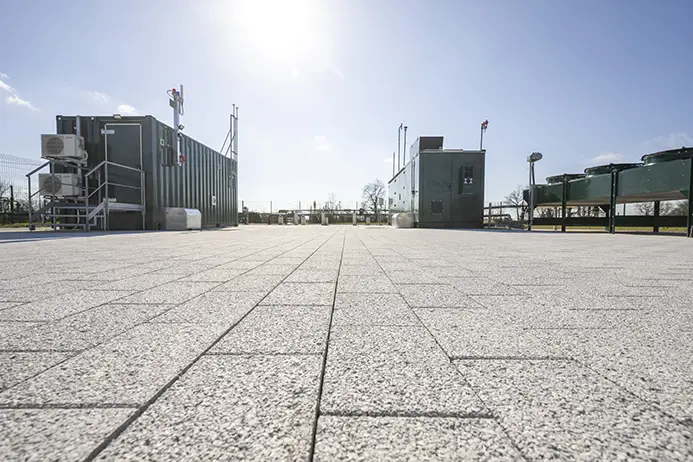
Trémentines Countdown Station (Maine-et-Loire) – permeable paving stones incorporating recycled oyster shells (photo: NaTran / Julien Gazeau)
In our projects and work, we give priority to avoiding environmental impacts. Where these cannot be avoided, we implement mitigation and, where necessary, compensation measures, working with specialist partners such as the Conservatoires d'Espaces Naturels, Regional Nature Parks or compensation operators.
We carry out a responsible maintenance of the easement strips - late mowing, removal of residues, adaptation of mowing heights - in order to limit the impact on flora and fauna and encourage ecological continuity. In addition, 100% of our major sites are now maintained without the use of synthetic plant protection products, and this "zero phyto" approach is gradually being rolled out across all our sites.
In 2023, NaTran carried out its first biodiversity footprint assessment with CDC Biodiversité (GBS framework), based on the Global Biodiversity Score (GBS) framework, The company works with Regional Nature Parks (PNR), the League for the Protection of Birds (LPO), Cerema and nature conservation organisations, and participates in the Act4Nature France initiative for habitat restoration and awareness-raising.
How does NaTran integrate its activities into the circular economy?
NaTran promotes a culture of austerity and develops the circular economy to serve local communities. We take action to reduce the consumption of resources and prevent the production, recycling and recovery of waste generated by our activities.
The development of renewable and low-carbon gases is a major driver of the circular economy. Methanisation, pyrogasification and hydrothermal gasification enable organic and industrial waste to be converted into local energy resources. NaTran is promoting solidarity between regions and is aiming for a production capacity of 60 TWh of renewable gas connected to the networks by 2030.
Sorting at source, on-site crushing of rubble, prioritising recycling and reusing equipment have raised the waste recovery rate to 98% by 2024.
Since 2022, NaTran has been collecting scrap metal from maintenance work and construction sites to benefit the charity Les P’tits Doudous, which improves the care provided to children undergoing surgery in hospital. Result: 926 tonnes of scrap metal and 443 kg of cables recycled, representing approximately 1,200 tonnes of CO₂ avoided according to ADEME’s emission factors.
Presentation of the activities of the association Les P’tits Doudous and the partnership
An integrated CSR policy (financial and extra-financial)
NaTran’s CSR policy is a reflection of the company’s core purpose. It is based on integrated governance and management, with a global approach to financial and extra-financial performance.
NaTran stands shoulder-to-shoulder with its stakeholders
NaTran’s CSR policy was co-constructed with more than 50 internal and external stakeholders, all of which share a common goal: to prioritise and establish clear commitments, accompanied by key indicators, to check and report on the implementation of actions.
Since 2016, NaTran has had a Stakeholder Council tasked with improving the integration of societal expectations and the challenges of Societal Responsibility. The body represents customers, regions and local authorities, the agricultural industry, suppliers and environmental associations. It provides NaTran’s general management with expertise, and gives an overview of way the company's activities and projects are perceived, as well as a broad understanding of the sphere in which it operates.
In 2022, NaTran’s societal responsibility also extended to 260 stakeholder commitments. These took the form of memberships, partnerships and sponsorships, more than 50% of which take effect directly in the regions.
In 2024, the Stakeholder Council will evolve to increase NaTran stakeholders’ involvement in the company’s governance. The new version of the Stakeholder Council will have a three-pronged mission: to contribute to assessing the company’s overall performance and the implementation of its core purpose; to take part in strategic questioning; and to establish interactions linking the Executive Committee and the Board of Directors.
Integrated CSR management
The close links between the CSR department and the finance department reflect NaTran’s desire to foster a global approach to performance and to manage each CSR commitment cross-functionally. The implementation of a single dashboard, monitored by the Executive Committee, allocates the same importance to financial and non-financial data. Each commitment is subject to an action plan and measured via indicators whose monitoring is audited and published in the Declaration of Extra-Financial Performance.
“The CSR policy is both the vector and the guarantor of NaTran’s core purpose. Integrating CSR into corporate governance and management decompartmentalises visions and skills. It reflects the company's strong, sincere desire to transform itself, to reinvent itself, and to effect the third gas revolution alongside its stakeholders, its employees and society.”Christophe Delfeld
CSR Director
Three questions for Christophe Delfeld, CSR and Environment Director at NaTran
Christophe Delfeld shares his views on the role of CSR in corporate governance, stakeholder engagement and supporting major transitions
How does the CSR approach link NaTran’s purpose, its strategy and its operational decisions?
CSR acts as the common thread linking the company’s purpose, the NaTran2030 initiative and day-to-day operations. It shapes priorities, informs investment and innovation decisions, and ensures consistency between industrial performance, environmental responsibility and social value.
How do societal and environmental expectations influence NaTran’s strategic trade-offs?
The double materiality analysis conducted under the CSRD has prioritised NaTran’s impacts, risks and opportunities. It provides concrete guidance for trade-offs in favour of decarbonisation, the development of renewable gases, biodiversity and resource efficiency.
What role does CSR play in securing the long-term commitment of teams and partners to the transformation?
CSR gives meaning to the transformation through shared responsibility: team involvement, eco-leaders, commitment-based management and structured dialogue with stakeholders. This collective mobilisation enables the transition to be embedded over the long term with consistency and confidence.