


Transportation of CO₂

The capture, storage and recovery of CO2 is a decarbonisation solution that complements energy efficiency gains and the development of renewable and low-carbon energies. CCUS (Carbon Capture, Usage and Storage) is one of the levers in the International Energy Agency’s (IEA) Net Zero Emission scenario, which targets 1 Gt of CO2 per year from 2030 and 5 Gt of CO2 from 2050.
Notre vision pour un monde neutre en carbone en 2050
In light of this, NaTran is working to implement CCUS by building dedicated transmission networks to convey CO2 from its location of capture to its place storage or recovery.
>>> Our commitments and challenges to succeed in the challenge of decarbonization
“NaTran is one of France’s major gas transmission stakeholders. It uses its expertise to support the deployment of new transmission networks to bolster decarbonisation efforts and meet the challenges of the energy transition. NaTran is committed to projects that unite all stakeholders in the value chain – from CO₂ emitters to energy recovery project owners – with a view to the industrial development of the regions.”Pierre-Yves Le Strat
Business Manager at the Division for Hydrogen and CO₂ Transport
CCUS: a solution for decarbonising industry
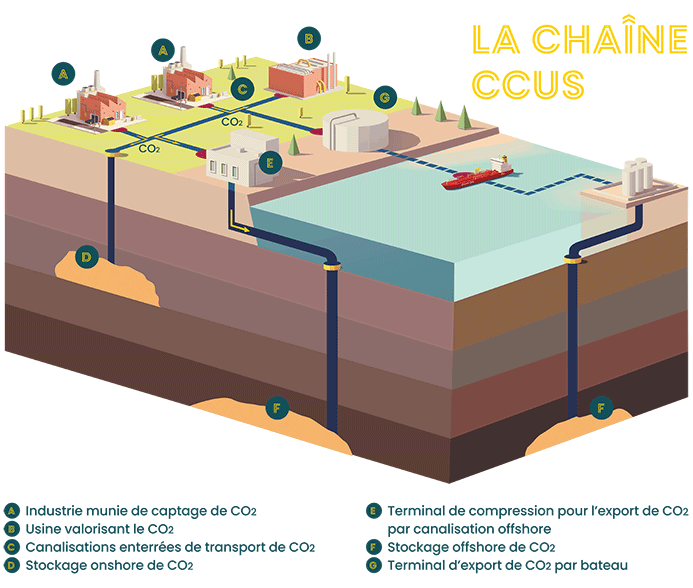
CCUS (Carbon Capture, Usage and Storage) refers to the capture, storage and recovery of CO2. The technique involves capturing CO2 emissions and sequestering them either in old hydrocarbon deposits or geological formations, or repurposing them for new industrial and energy uses (synthetic fuels, etc.). This is a decarbonisation solution for industrial sectors that emit large amounts of CO2 and which have no sustainable decarbonised energy alternatives.
CCUS requires an efficient transmission network to convey very large quantities of CO2 from its location of capture to its place of recovery or storage. And this is where NaTran comes in, with its dedicated transmission infrastructure adapted to the task.
The CCUS chain
What is the current status of France’s CO2 transmission projects?
As a matter of priority, NaTran is taking steps to meet the needs of the France’s first national-level projects spread over the three industrial zones with the country’s highest CO2 emissions:
Dunkirk Basin
With an initial capacity of 3 to 4 Mt CO2/year, the project aims to develop a CO2 pipeline network in the industrial port area of Dunkirk. The project also includes compression facilities to connect the network to the offshore pipeline developed by our partner Equinor. Thanks to this interface with Equinor's CO2 Highway Europe project, DKHARBO offers French carbon-intensive industries reliable, competitive and large-scale access to permanent CO2 storage capacities developed in the North Sea. Basic engineering studies for the project began in 2025. They follow on from feasibility studies carried out in 2023 and 2024 and are supported by the European Union through CEF-E funds. The aim is to bring the project into service in 2031/2032.
Saint-Nazaire – Montoir-de-Bretagne - GOCO2 project
In partnership with Elengy and various major industrial CO₂ emitters (LAFARGE, HEIDELBERG MATERIALS, LHOIST), the GOCO₂ project aims to capture CO₂ from industrial sites and transport it to the Saint-Nazaire maritime export terminal for delivery to geological storage sites. Capacity is estimated at 2.3 million tonnes per year by 2030. It could eventually transport and export up to 4 million tonnes of CO2 per year by 2050. Basic engineering studies (FEED) are currently being launched. The project was the subject of preliminary consultations from September to December 2025, under the aegis of the National Commission for Public Debate. In parallel with these studies, a funded technical and economic analysis was launched to cover the needs of more widespread emitters/consumers in the Greater West region.
EU-ETS C02 emissions (2019)
Dorling cartogram of EU-ETS CO2 emissions in 2024
Verified GHG emissions from installations in metropolitan France subject to the EU Emissions Trading System.
The circles are proportional to the quantity of emissions and, where necessary, displaced as little as possible to avoid overlaps.

Source: EU ETS CO2 emissions 2005-2024 in mainland France + Corsica
Implications for NaTran
NaTran is establishing itself as a key player in the implementation of CCUS chain in France. Together with its partners, it promotes the development of the CO2 capture, storage and utilisation sector in France.
NaTran is a member of the “CO2 Club”. The association now brings together 92 French CCUS players. As a point of contact for public authorities, it is a forum for discussion, feedback and initiatives.
NaTran co-leads the CCUS working group within the CSF Nouveaux Systèmes Énergétiques (New Energy Systems) with TotalEnergies and Technip Energies.
NaTran also promotes the vision of CO2 transport via carbon pipelines to support the Energy Transition within the European associations CCSA, ENTSOG & GIE and during consultations with the European Commission and the French government on their strategic and legislative visions for decarbonisation.
Consultation and dialogue with market stakeholders
All transportation of CO₂projects

