Methanisation: the key role of the reverse systems
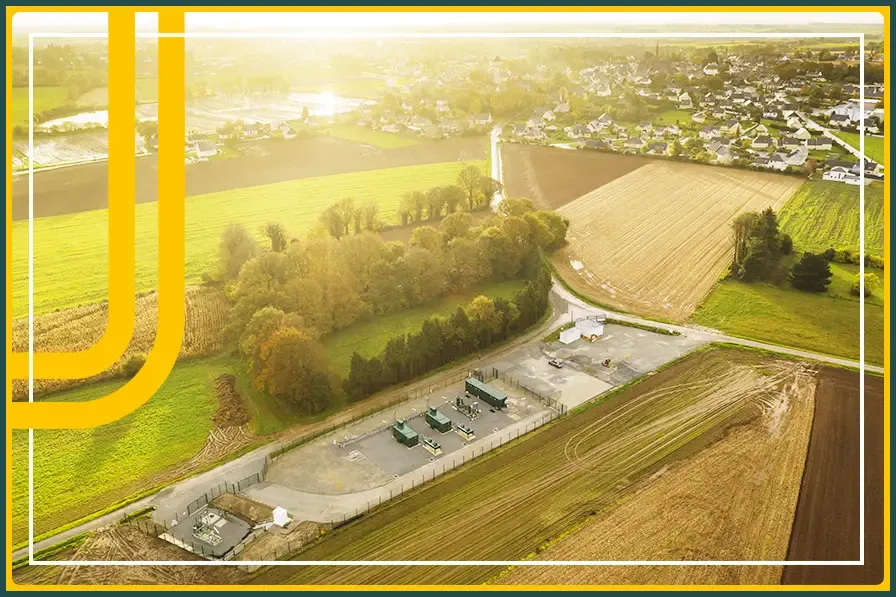
The continued growth of renewable gas production in France requires the presence of an essential technical and strategic link, developed by NaTran in the territories: the reverse stations. Presentation.
In France, methanisation is booming
Methanisation is the most mature renewable, low-carbon gas production option in France. The principle is simple: transform organic waste (livestock manure, agricultural residues, bio waste, etc.) into biogas which, once purified, becomes biomethane that can be injected into gas networks, in particular the NaTran transmission network.
Installed biomethane production capacity exceeded 16 TWh in mid-2026. By the half of 2026, France had more than 837 methanisation facilities connected to the grid, a figure that will continue to rise over the coming years.
However, local biomethane production can sometimes exceed local needs, particularly in summer and in sparsely populated areas. A solution had to be found to make use of these surpluses and prevent the biogas plants from having to limit or even temporarily halt their production.
This solution is the reverse stations.
Reverse systems, essential tools for the methanisation sector and the energy transition.
A reverse station is a small compressor station that activates automatically to capture excess biomethane produced in a given area and redirect it via the transmission network to:
- More distant and larger consumption areas (urban areas, industrial sites);
- Storage areas for future needs, in winter for example.
Reverse systems get their name from the fact that they reverse the historical flow of gas (which usually goes from the transmission network to the distribution network). The station compresses the surplus biomethane circulating in the distribution network so that it can be injected into the high-pressure pipes of NaTran's transmission network. Thanks to them, the network becomes bidirectional.
Through their actions, the reverse systems ensure that biomethane producers in a given area have a permanent outlet for their production. For this reason, they are key elements in the development of the methanisation sector in France. They avoid wasting a local renewable gas and optimise its use on a national scale, in the context of steadily falling natural gas consumption.
Reverse systems are therefore discreet but effective accelerators of the gas energy transition.
How does a reverse station work?
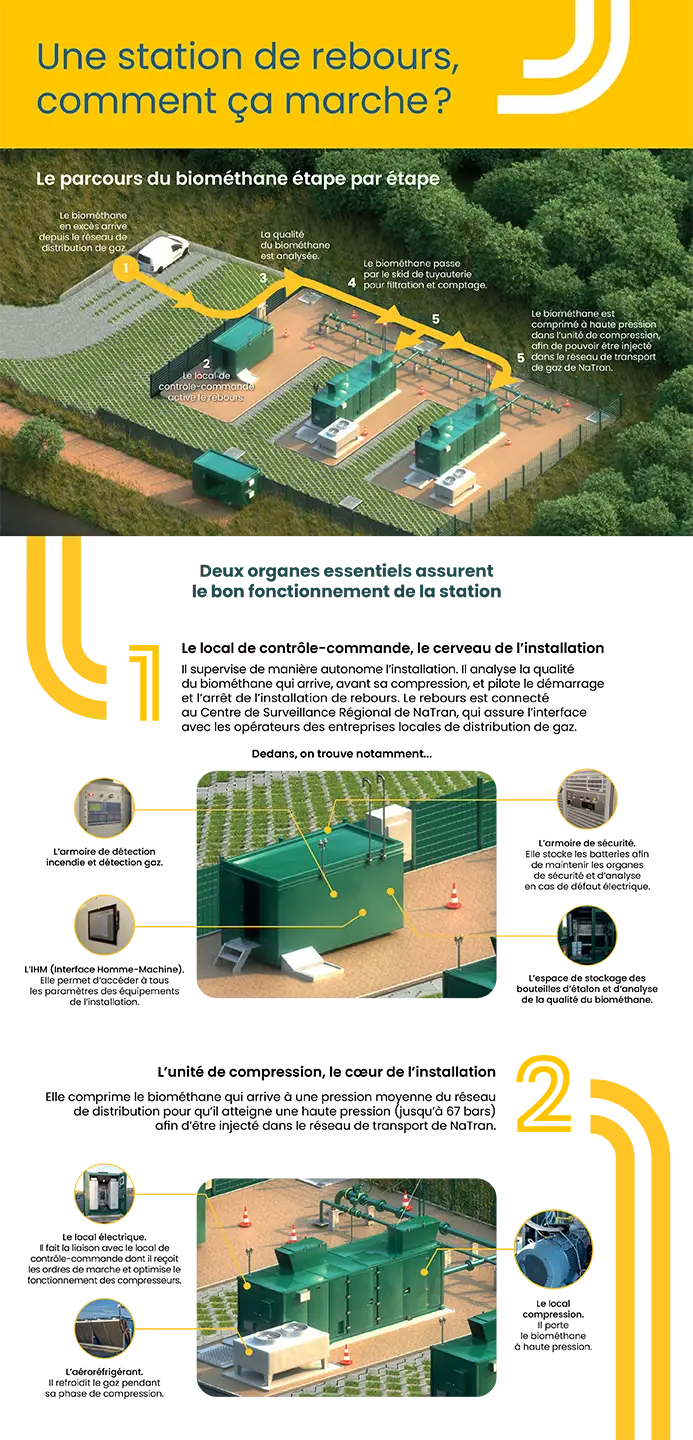
>>> Infographic in PDF format: How does a reverse station work?
The reverse systems, levers of development for the territories
By securing the outlets for biogas plants, the reverse systems:
- Support agricultural activity and diversify income for farmers;
- Encourage the creation of jobs in local collection, treatment and operation sectors;
- Consolidate regional energy independence;
- Contribute to the circular economy, by locally reusing organic waste.
NaTran's leading role in the development of reverse systems in France
As a major gas transmission operator in France committed to the energy transition, NaTran deploys and manages an expanding strategic network of reverse systems throughout its territory. These stations are part of an overall strategy of the methanisation sector, at the crossroads of energy, environmental and local issues.
NaTran works with local actors – local authorities, biomethane producers, industrialists, distribution operators – in defining needs, designing and commissioning reverse systems, while ensuring their interconnection to the national grid.
These actions will help to smooth the flow of biomethane and support the ramp-up of the sector, which has set itself the target of producing 44 TWh of renewable gas by 2030.
An innovation: "transport-transport" reverse systems
To support the growth of the methanisation sector, NaTran is also developing a new type of reverse system capable of linking different sections of its transmission network. The first of these "transport-transport" reverse systems will be inaugurated in July 2026 in Côtes-d'Armor.
In areas not covered by the distribution networks, these reverse systems constitute real levers of development for the industry. Combined with the creation of extensions to the transmission network - thanks to polyethylene (PE) pipes, in which the gas will flow at lower pressure - they will enable NaTran to develop new biomethane collection offers where they do not yet exist.
Reasoned development in line with needs
NaTran, one of the world leaders in the development of reverse systems, is acting in a reasoned way in terms of both locations and costs, under the supervision of the French Energy Regulatory Commission (CRE), which guarantees this balance.
"The decision to invest in the construction of new reverse systems is based on a rigorous process: consultation with the distributors, definition of a connection zoning, then validation by the CRE, which ensures the relevance of each project during the study phase, then the construction of the reverse system," explains Céline Heidrecheid, Director of Renewable Gas at NaTran.
On 3 September 2025, CRE approved the launch of the construction phase for 11 reverse projects and the launch of the study phase for 8 new projects for NaTran.
Controlled costs have also enabled NaTran to significantly reduce its costs over time. The cost of installation between the first reverse system, commissioned in 2019, and the most recent systems has fallen from €3 million to €2.5 million.
Eco-design and environmental integration
In addition to its economic performance initiatives, the company has also launched an eco-design and environmental performance process covering the entire life cycle of its products.
It focuses on two themes: reducing the environmental impact of reverse systems and reducing their carbon footprint throughout their lifespan.
On the first point, protecting the biodiversity of local flora and fauna is becoming a major issue in the development of our reverse systems in rural areas mostly. This involves very practical landscaping measures, such as grassing and planting with local species, removal of artificial surfaces from soils, installing permeable and innovative surfacing, reducing the amount of land required
The reverse systems, supporting the long-term development of methanisation over time
Since 2018, reverse system commissioning has experienced a strong acceleration. At the 2d half of 2026, 40 reverse systems were in service on the NaTran network, 37 under construction and 38 in the study phase. The sustained development of reverse systems will continue, with over a hundred rever systems being planned in France by 2030 to support and secure the development of methanisation.
Their location is visible in real time on the ODRE map - Open Data Energy Networks.