Success of the call for expressions of interest for the inter-regional CO₂ transport infrastructure

NaTran is pleased to announce the successful outcome of its call for expressions of interest (CEI) for the inter-regional CO2 transport infrastructure project covering the Hauts-de-France, Grand Est, Normandy and Île-de-France regions.
This success confirms the emergence of a French CO₂ market
A diverse range of stakeholders, from CO2 producers to CO2 conversion initiatives, demonstrated strong interest in the CEI, reflecting confidence in the developing French CO2 market. The CEI identified a total volume of 16.7 million tonnes of CO2, approximately 27% of emissions generated by the French manufacturing industry, available for capture and transport for subsequent conversion or permanent storage. These findings underscore the demand for a large-scale infrastructure project that will support decabonisation targets while boosting economic attractiveness at the regional level.
More than 200 responses from stakeholders covering the entire CO2 value chain
NaTran has received over 200 submissions from stakeholders across Hauts-de-France, Grand Est, Normandy and Ile-de-France, representing every segment of the CO2 value chain:
- Nearly 90 industry players, including manufacturing sites, waste management companies, biomass plant and incinerator operators;
- Over 100 methanisation facilities looking to convert their biogenic CO2;
- Five CO2 volume aggregators which, by sharing injection points, can integrate small-scale CO2 producers and optimise CO2 transport at the regional level;
- A sovereign storage project in the Paris region.
Additionally, the CEI singled out CO2, export projects via maritime terminals or deep-sea pipelines to permanent storage sites in geological formations, as well as CO2 capture site (primarily for e-fuel production), thereby supporting the development of a circular carbon economy in France.
The total transportation demand identified reached 16.7 million tonnes of CO2 annually, representing approximately 27% of French manufacturing emissions and 4.5% of national CO2 emissions.
These findings confirm the significant availability of biogenic CO2 , amounting to 6.4 million tonnes per year out of the total 16.7 million tonnes. Substantial demand has also been identified for the conversion of this CO2, totalling 2 million tonnes annually.
The largest volumes have been identified in the Grand Est and Normandy regions. CO2 producers from Luxembourg, Germany, and Switzerland have also shown interest in NaTran, adding a cross-border dimension to the project.
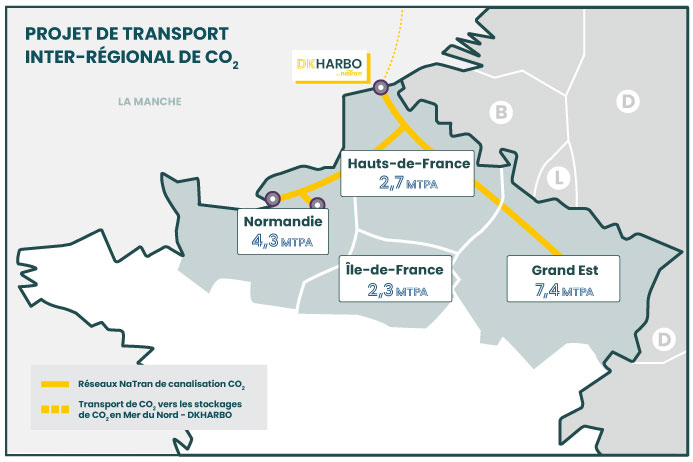
>>> Download the map in PDF format
NaTran will leverage these insights to initiate a feasibility study in collaboration with all stakeholders and public decarbonisation initiatives.
1 Biogenic CO2: CO2 produced from biomass, which consists of recent and renewable organic matter (plants, organic waste, agricultural or forestry residues). Unlike fossil-derived CO2, biogenic CO2 is part of the natural carbon cycle, as it originates from carbon captured by plants during their growth phase. As a result, its re-emission or conversion has a neutral impact on the climate.
A decarbonisation project for northern France
The NaTran-led project is set to become a major CO2 transport backbone project stretching approximately 1,000 kilometres across four French regions (Grand Est, Hauts-de-France, Normandy, Ile-de-France). This extensive network will link carbon capture and utilisation projects, primarily situated in key industrial hubs such as the Seine Valley and Dunkirk Port.
Underpinned by the CCUS (Carbon Capture, Utilisation and Storage) technology framework, the project aims to transport captured CO2 emissions to conversion or storage sites, notably through interconnections with the DKHARBO project in Dunkirk. Developed by NaTran in partnership with Norwegian energy company Equinor, DKHARBO is designed to connect Dunkirk Port with permanent geological storage facilities located in the North Sea. The integration with Dunkirk and the DKHARBO project, which serves as a CO2 export hub, thus enhances large-scale transport capacity.
“The NaTran-led project addresses a genuine demand from economic stakeholders and regional authorities pursuing decarbonisation initiatives and the development of emerging e-fuel sectors. We already acknowledge the positive impact of CCUS technology, and this CEI further strengthens our commitment to advancing this innovative solution intended to support the energy transition and industrial sovereignty,”Anthony Mazzenga
Development Director at NaTran
Deployment of several projects in France
The inter-regional CO2 transport project, covering the broad north-eastern quarter of France, fully aligns with NaTran’s 2030 corporate strategy, which aims to develop 1,000 kilometres of hydrogen and CO2 networks by 2030. In addition to this inter-regional transport venture and the DKHARBO initiative, NaTran is also advancing a CO2 transport project in the Grand Ouest region, known as GOCO2. Collectively, these projects represent the first phase in the phased deployment of a nationwide, interconnected CO2 transport network.