Project to convert L-gas to H-gas
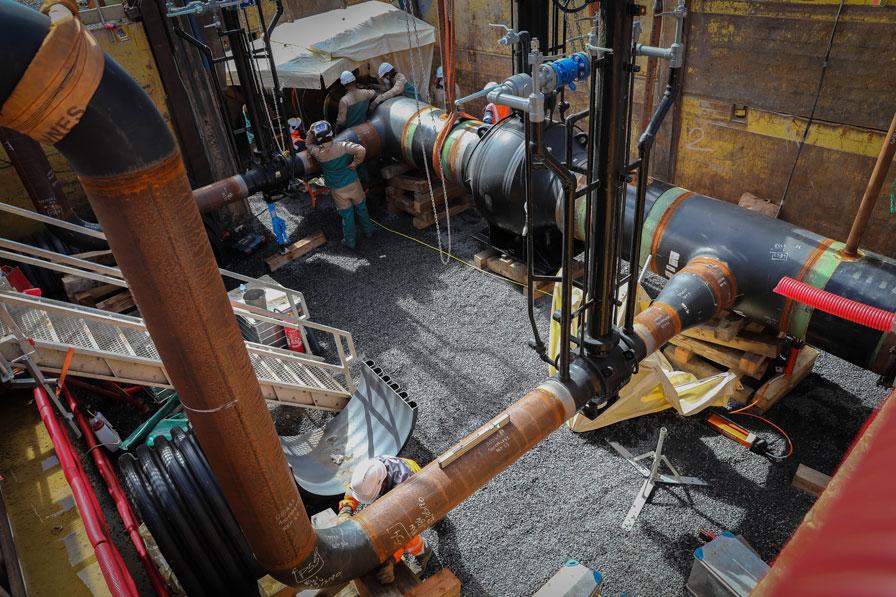
Converting the L-gas network to H-gas
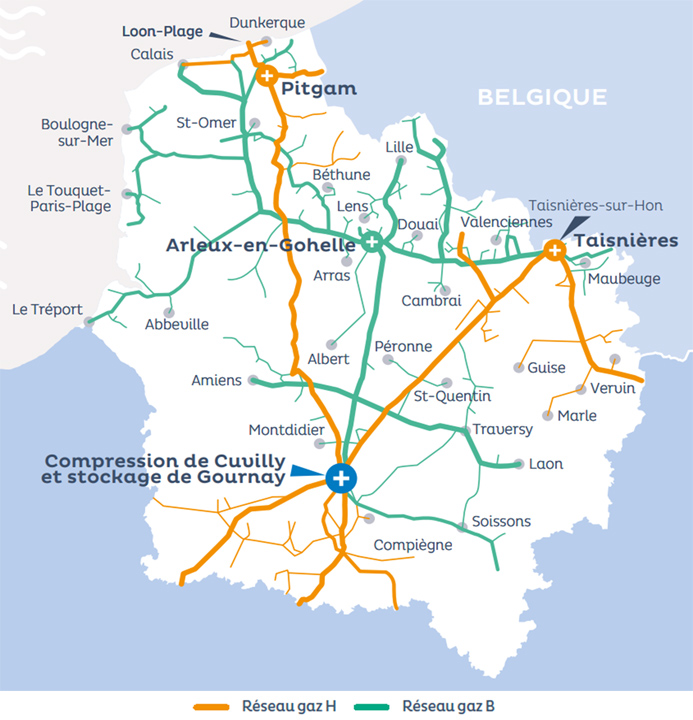
Historically, the Hauts-de-France region was supplied with B gas (Low calorific value) and accounted for 10% of French consumption in 2018 (approximately 1.3 million customers). This gas came primarily from the Groningen field in the Netherlands. The gradual depletion of this field and the seismic risks associated with its operation required a shift in supply sources. Thus, a conversion program was launched in 2019 across all transmission and distribution networks to transport H gas (High calorific value) throughout France. This conversion requires an intervention at the premises of every gas-consuming customer to adapt their installations. NaTran anticipates the end of France's B gas supply by the end of October 2027.
Note: Since the closure of the Groningen field in October 2024, zone B has been supplied by B+ gas production from the Netherlands.
From low to high:
L-gas to H-gas
The composition of natural gas varies depending on its origin and affects its energy content: the higher the nitrogen content of natural gas, the lower its calorific value—the amount of heat released by its combustion.
A distinction is made between:
- B gas (Low calorific value), coming mainly from Groningen, which contains a higher nitrogen content. It supplied the North of France;
- H gas (High calorific value), coming from the North Sea, Russia, and Algeria, which supplies the rest of the country.
A progressive conversion plan between 2016-2027
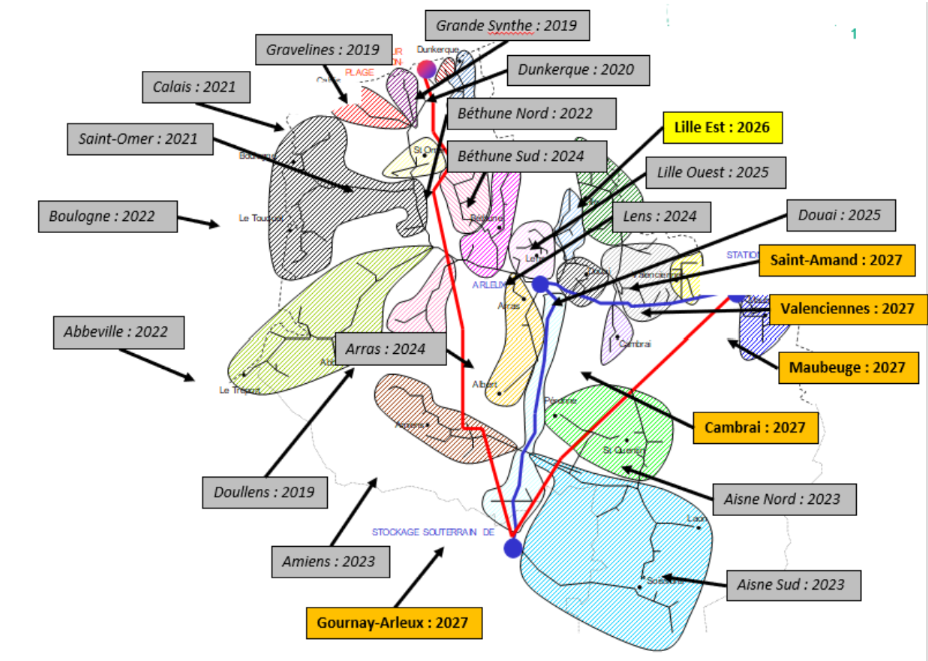
The conversion to H gas of the initial B gas consumption zone relies on dividing the B gas transmission and distribution networks into around twenty geographical sectors. The change in the type of gas transported is carried out independently and sequentially for each sector. This allows for a progressive conversion of the entire zone until 2027, at a pace compatible with the interventions required for each of the 1.3 million customers involved.
Map of sectors to be converted
A coordination committee is provided for by Decree No. 2016-348 of March 23, 2016. Under the authority of the ministers responsible for energy, industrial safety, and the economy, it brings together the relevant stakeholders:
- CRE (French Energy Regulatory Commission),
- Gas supplier representatives,
- Gas network operators,
- The storage operator,
- Mine gas and biomethane injection operators,
- Equipment manufacturers and gas professionals,
- The French Gas Association (Association Française du Gaz),
- The relevant granting authorities,
- Consumer associations and energy trade union federations, each of which appoints a representative.
This committee determines the priorities and various guidelines, and ensures compliance with the conversion schedule.
Pilot Phase: 2019 to 2020
- 4 sectors converted
- 80,000 GRDF customers and 7 NaTran customers
Phase 1: 2020 to 2024
- 11 sectors converted
- 550,000 GRDF customers and 54 NaTran customers
Phase 2: 2025 to 2027
- 8 sectors converted
- 680,000 GRDF customers and 32 NaTran customers
France is not the only country impacted by the production decline at the Groningen field (Netherlands). European coordination regarding B gas has been established within the Task Force Monitoring L-Gas Market Conversion, and the various affected Member States meet regularly (Germany, Belgium, France, Luxembourg, Netherlands).
A collaboration agreement regarding the conversion from B gas to H gas in Belgium and France was also signed between Gasunie Transport Services (GTS), Fluxys, and NaTran. In addition, regular technical exchanges are organized between Belgian, German, and French operators. The project to adapt the B gas to H gas transmission networks in France and Belgium was part of the European Union's Projects of Common Interest between 2018 and 2022.
Toolbox and useful links
Publications