Transporting CO₂ to decarbonise industry

Thursday 15 January 2026
On 16 December 2025, NaTran launched a call for expressions of interest (AMI) for an inter-regional CO₂ transport project linking the major industrial basins of a large north-eastern quarter of France to recovery and geological storage solutions. A look back at a key infrastructure for industrial decarbonisation
An industrial project at the heart of the energy transition
Carbon neutrality by 2050 is a reality. For French industry, this means a complex equation: reduce emissions as far as possible and neutralise those that cannot be avoided.
The recovery and storage of CO₂ are therefore included in European and French climate strategies, identified as essential levers for dealing with so-called residual or fatal emissions from certain industrial sectors, such as cement, steel, heavy chemicals or waste-to-energy. These are precisely the sectors covered by NaTran's inter-regional CO₂ transport project for the north-east quarter of France.
"Industrial decarbonisation also requires the ability to deal with emissions that cannot be eliminated.”Pierre-Yves Le Strat
H₂ and CO₂ development project manager at NaTran
Project objectives
This project aims to create a CO₂ pipeline transport infrastructure linking Hauts-de-France, Grand Est, Normandy and Île-de-France. The aim is to provide manufacturers, waste managers and operators of heating plants or methanisation units with a shared solution for transporting the captured CO₂ to recovery or permanent geological storage sites. Designed as an inter-regional backbone of around 1,000 kilometres, the future network could transport up to 10 million tonnes of CO₂ per year, or around 13% of emissions from French manufacturing industry.
"The network we are planning will have to support the diversity of industrial projects, whether they involve permanent storage or CO₂ recovery. We want to offer a robust, scalable and open solution.”Stéphane Maurel
Network Project Director H₂ and CO₂ at NaTran
Territorial coherence across the northern region of France
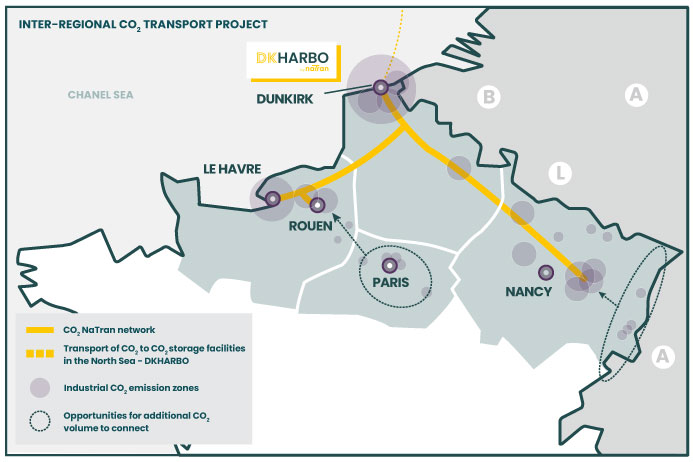
The strength of the project also lies in its geographical dimension. The regions concerned are home to a significant proportion of France's industrial emissions, as well as emerging CO₂ capture and recovery projects. The route studied in the pre-feasibility phase aims to link the main emission basins of Hauts-de-France, Grand Est and Normandy, with a connection to the Seine Valley and Île-de-France. The network will enable the captured CO₂ to be transported to reprocessing sites, but also to the port of Dunkirk, where the DKHARBO project led by NaTran in partnership with Equinor (a Norwegian company, a pioneer in CO2 storage in Europe), paves the way for CO2 to be transported by undersea pipeline to permanent geological storage sites in the North Sea.
Inter-regional CO2 transport project map
NaTran, coordinator of an ecosystem under construction
As part of this project, NaTran is providing a common technical, economic and industrial framework for local players. Drawing on the lessons learned from pioneering projects such as GOCO2 in Western France, NaTran is positioning itself as a key player in the structuring of the future CO₂ market. The call for expression of interest is a key stage in this process. It is aimed at all the players involved in the CO₂ chain: industrial emitters, waste managers, operators of heating plants, incinerators or methanisation facilities, developers of CO₂ recovery projects, as well as logistics players likely to connect to the future infrastructure. Open until 28 February 2026, it is voluntarily non-binding. It aims to identify needs, qualify the potential volumes of CO₂ to be transported, list capture, recovery or storage projects and measure the economic interest of such infrastructure.
On the basis of feedback from the market, NaTran will be able to refine the sizing of the network, adapt the routes and define, in a later phase, the conditions of access to the works and the decision-making procedures for their construction.
"This call for expression of interest is a tool for dialogue with local authorities and manufacturers. It allows us to build a project as close as possible to the realities on the ground, before undertaking in-depth feasibility studies."Pierre-Yves Le Strat
H₂ and CO₂ development project manager at NaTran
Learn more about the inter-regional CO₂ transport project
ndustrial decarbonization and CCUS