Biodiversity: NaTran is restoring its sites
Over the past two years, NaTran has been rolling out an environmental policy across more than 5,000 sites that is revolutionising its industry standards. Complete phasing out of plant protection products, support from ecologists, nature surveys, systematic restoration… some sites have already been awarded the LPO Refuge or EcoJardin environmental accreditation.
“The aim is to foster biodiversity wherever possible and in a sustainable way”.Pierre Billet
Biodiversity Officer at NaTran
An environmental strategy that is scaling up
The environment: a strategic priority of the NaTran2030 project
The company is committed to reducing its impact on the climate, biodiversity and land use –three global systems on which its 32,500 km network exerts direct pressure. This strategic plan has now been set out in a costed roadmap, particularly for large sites covering more than three hectares: around thirty such sites, representing a total of 200 hectares.
“These large sites will need to have a Consultative Ecological Management Plan (PGEC) in place and obtain environmental accreditation by 2030”, says Pierre Billet, Biodiversity Officer at NaTran.
From zero pesticide use to ecological management: a major cultural shift
The first turning point was a radical one: the complete phasing out of synthetic plant protection products across all NaTran sites within three to four years. This decision has turned historical notions of a ‘well-maintained site’ on their head; such a site used to be a gravel-covered area, completely bare, without a single blade of grass. Now, wild vegetation is reappearing: sometimes manageable, sometimes invasive. This shift requires rapid adaptation, including an understanding of which tree species to avoid, adjusting vegetation heights to maintain manageability, and accepting more natural-looking landscapes. Support is provided through an internal network, informed by extensive dialogue with the company’s partners. And little by little, the NaTran teams are embracing this new philosophy. The first late mowings were trialled away from visible areas and then rolled out more widely.
“Nothing spectacular at first glance, but these are changes that profoundly alter the lives of the local wildlife” souligne Pierre Billet.
2025: the first recognised sites
Some sites have already been awarded the Refuge LPO* and EcoJardin**, accreditations, confirming a complete shift in practices: habitat mapping, a review of maintenance methods, targeted improvements and expert monitoring. “We don’t want to give ourselves high marks; we need to be challenged” sums up Pierre Billet
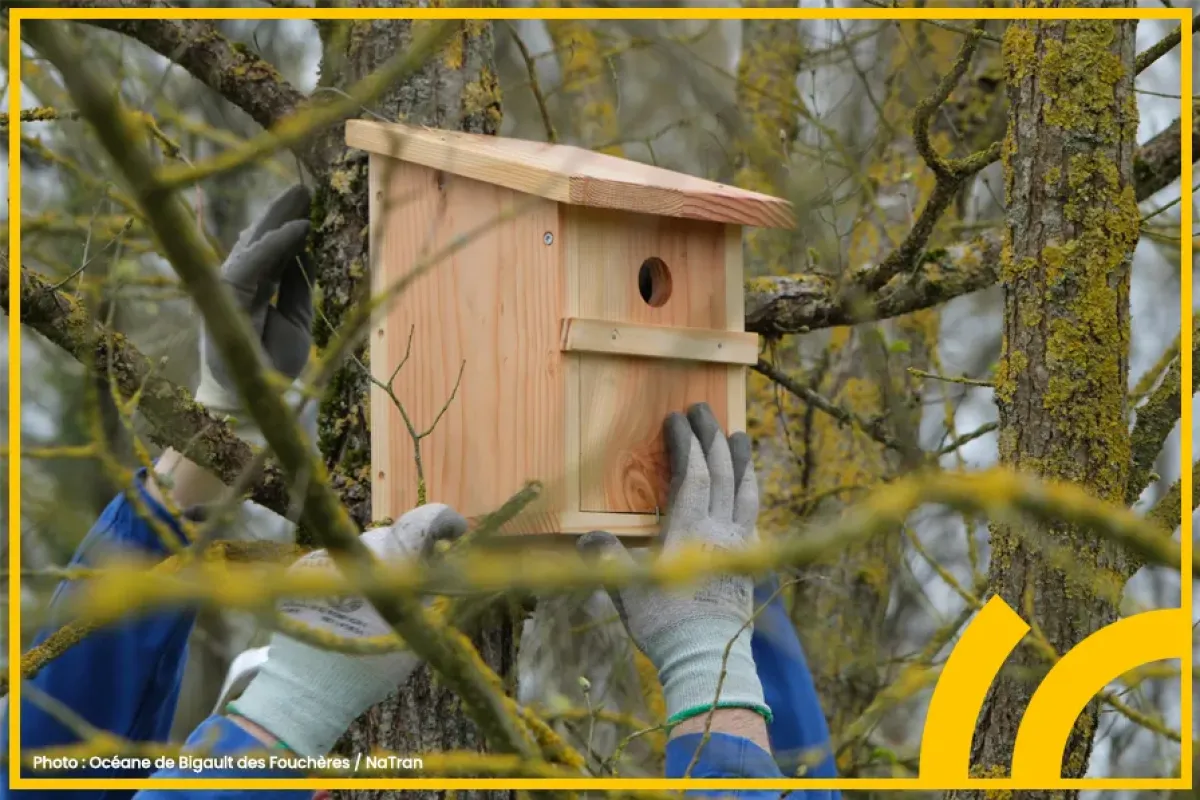
In 2025, four pilot sites paved the way. Pitgam (Nord), Saint-Victor (Allier) and Vindecy (Saône-et-Loire) have been awarded LPO Refuge status following extensive support: bird surveys, the installation and monitoring of nesting boxes, the reconfiguration of areas for late mowing, and the creation of micro-habitats.
For its part, Taisnières-sur-Hon (Nord), which has been supported for over ten years by the Avesnois Regional Nature Park, has been awarded the EcoJardin label, thanks to its exemplary management and in-depth knowledge of its local environments.
“These pioneers served as a methodological blueprint: how to choose the right measures, how to win over the teams, how to organise scientific monitoring, how to engage with local partners…” explains Pierre Billet.
*LPO (League for the Protection of Birds) : Founded in 1912, the LPO works to protect nature through three main missions: understanding and conserving biodiversity; preserving and managing natural areas; and promoting environmental education and public engagement.
**EcoJardin enables green space managers to showcase their commitments to the environmentally friendly management of their green spaces. The audit required to obtain the label, carried out by an independent body, is based on clearly defined criteria.
“Operators remain the driving force behind change: they are the ones who test mowing methods, adjust their crops, monitor nesting boxes and learn to manage vegetation in new ways”Pierre Billet
Biodiversity Officer at NaTran
The pivotal role of the bEES programme
Rolled out gradually from 2023 and fully operational since 2025, the bEEs programme has established itself as the backbone of NaTran’s green transition. It brings together a cross-functional team of around ten people (from the biodiversity, operations, research and innovation departments, etc.) tasked with defining methods, supporting operators, selecting partners and ensuring consistency across the country. “Operators remain the driving force behind change: they are the ones who test mowing methods, adjust their crops, monitor nesting boxes and learn to manage vegetation in new ways” souligne Pierre Billet.
The bEEs teams are here to share operational expertise, which is documented in a knowledge base, and to assess the precise impact of actions. Each site involved therefore benefits from a bespoke management plan, ranging from naturalist surveys to the selection of management measures (ponds, hedges, nesting boxes, sustainable mowing), including an analysis of operational constraints. It is thanks to this structured framework that the Collaborative Ecological Management Plans (PGEC) can be rolled out, that LPO and EcoJardin accreditation becomes achievable, and that the internal culture evolves.
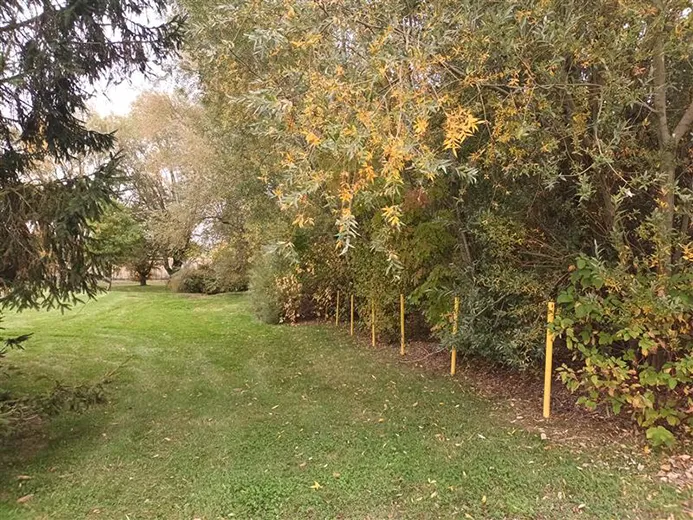
EcoJardin accreditation of Taisnière-sur-Hon station (Nord) - Photo: NaTran / Christophe Dewailly
About bEEs
Established in 2023 as part of NaTran’s environmental policy and its CSR policy (commitments to ‘Biodiversity and Land Use’), bEEs is an eco-support initiative comprising staff from various departments whose mission is to support teams in their biodiversity initiatives implemented at the sites and in the sectors for which they are responsible.
2026: the rapid expansion of the bEEs programme
The year 2026 marks a phase of acceleration.
Ten sites are launching LPO surveys, including Dierrey (Aube), Morelmaison (Vosges), Cerville (Meurthe-et-Moselle) and Laneuvelotte (Meurthe-et-Moselle). On the western side, Cherré-Au (Sarthe) and Auvers-le-Hamon (Sarthe) are supported by the Permanent Centre for Environmental Initiatives (CPIE).
“Châteauroux, which is one of NaTran’s major logistics sites, is currently implementing a structured plan to plant hedgerows in partnership with the Pays Castelroussin Val de l’Indre”. Roussines (Indre) will soon be digging a pond. "Several operations have already received their spring nesting boxes," explains Pierre Billet. NaTran has set aside a specific budget for these improvements: €150,000 in 2026. A modest sum on a company-wide scale, but one that is crucial for scaling up practical initiatives. “The key issue isn’t the cost: these are simple changes, but they need to be decided upon, monitored and incorporated into our practices” points out Pierre Billet.
In Saint-Herblain (Loire-Atlantique), a commercial development currently under construction has incorporated biodiversity features into the design from the outset.
Eco-design: when biodiversity is incorporated into building plans
This momentum extends beyond management: NaTran also wants to rethink construction standards.
An internal eco-design guide is currently being rolled out to raise awareness amongst teams about land-use efficiency, reducing impervious surfaces, optimising materials, and the systematic integration of carbon and biodiversity criteria.
The Trémentines area (Maine-et-Loire) has become a showcase: permeable paving stones incorporating recycled oyster shells, capable of reducing the surface temperature by 5 to 10 °C in summer compared with conventional asphalt. A circular innovation that produces fewer emissions and is better suited to climate change. “What we are building now must set an example”, insists Pierre Billet. In the future, a gas station may feature a gravel-and-stone surface, hedges along the boundaries of the site, well-maintained but living grassed areas, and permeable surfaces wherever possible.
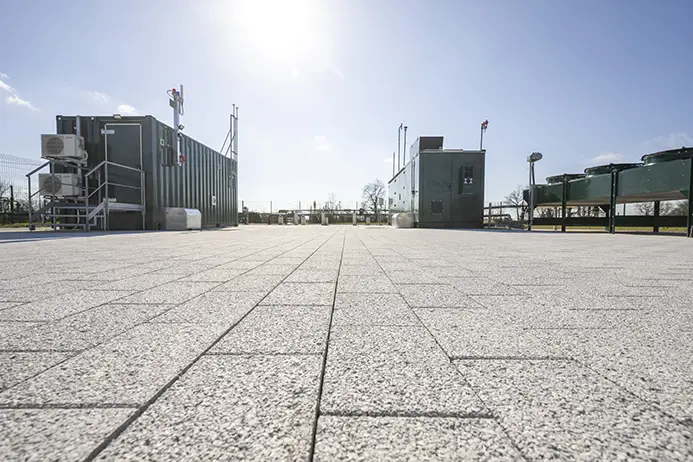
Trémentines Countdown Station (Maine-et-Loire) – permeable paving stones incorporating recycled oyster shells (photo: NaTran / Julien Gazeau)
Spotlight on La Pépinière collective
As part of the NaTran initiative, comprising a team of expert and committed staff, La Pépinière implements initiatives and best practices aimed at project stakeholders (site managers, project leaders, supervisors, etc.) to support environmentally responsible construction projects. To date, more than 35 best practices have been identified, grouped by theme: Preserving natural habitats, making the most of resources, taking action on climate change… The oyster shell paving at the Trémentines reverse flow station is one of the initiatives launched by the collective...
“In the coming months, between six and ten new LPO Refuge and EcoJardin accreditations are expected to be awarded”Pierre Billet
Biodiversity Officer at NaTran
This is only the beginning...
Behind the ponds, hedges and bird boxes, a systemic transformation is taking place.
Teams are increasingly analysing the environmental impact of projects; operators are learning to evolve a profession that had remained very mineral-focused; and conservation partners are becoming operational allies. NaTran has chosen to view the preservation of biodiversity as an opportunity.
The momentum is here.