Recover non-usable waste with pyrogasification
Syctom has established a partnership to conduct pyrogasification trials, a technology used to convert non-usable or low-value solid waste into gas that can be injected into networks.
Syctom, NaTran, Citeo and Ecomaison have partnered up to carry out pyrogasification tests with the aim of accelerating the technological and economic viability of a waste recovery sector using pyrogasification to produce network-injectable gas.
An innovative project that is fully aligned with Syctom’s scientific programme and its decarbonisation initiatives.
Pyrogasification, a promising technological solution
An innovative project that is fully aligned with Syctom’s scientific programme and its decarbonisation initiatives.
Pyrogasification stands as a promising technological solution that contributes to the ecological transition of regions through the production of renewable energy. Several pilot and demonstrator projects have been implemented in recent years across France and Europe, particularly in the field of energy recovery from biomass inputs (both dedicated and residual) not utilised in methanation.
Trials on sorting rejects from bulky waste items
Syctom intends to recover energy from the sorting rejects of bulky waste originating within its region. As an initial phase, the project will conduct trials in collaboration with pyrogasification sites to achieve a detailed characterisation of the gas and char produced during the gasification process.
Following this, the aim is to organise a consultation with stakeholders in the syngas, or synthesis gas, treatment ecosystem to conduct a thorough technical and economic evaluation of solutions for converting syngas into a gas suitable for injection into distribution networks.
An innovative technology to reduce CO2 emissions
Pyrogasification is a thermochemical process that involves heating solid waste at very high temperatures (approximately 1000°C to 1500°C) in the absence of, or with very limited, oxygen. Unlike in incineration, waste is not directly burned in pyrogasification, thereby significantly limiting CO2
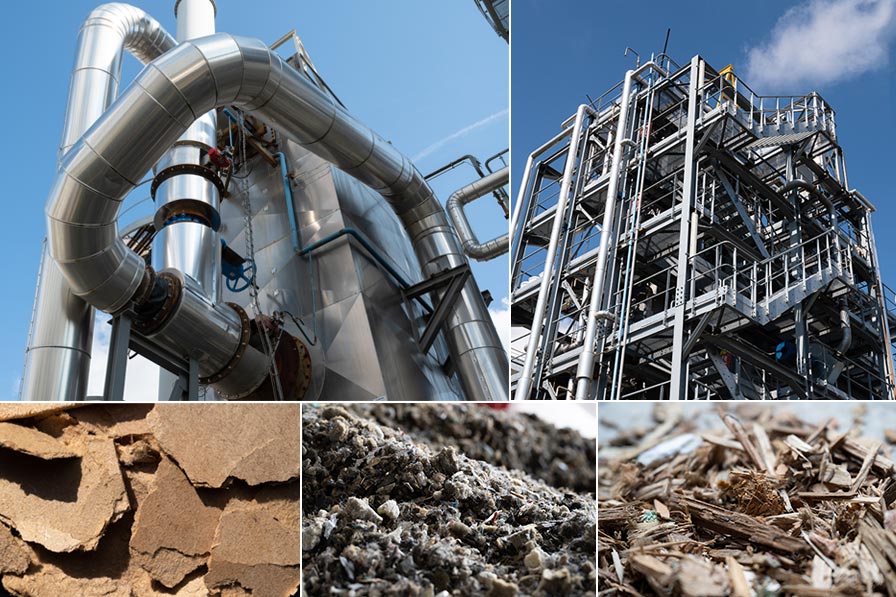
This process enables the conversion of relatively dry organic materials – such as woody biomass, end-of-life wood, agricultural residues – and a range of carbon-rich waste, including non-recyclable tyres and dried sewage sludge, into energy-dense compounds. Depending on the specific process employed, these compounds can be produced in solid form (biochar/char), liquid form (oils) or gaseous form (synthetic gas or syngas), all of which preserve their energy potential for future use.
About Syctom, Citeo and Ecomaison
Syctom – the metropolitan household waste agency
Syctom is the public service responsible for the treatment and recovery of household waste in 82 municipalities across the Île-de-France region.
Citeo
CITEO Household Packaging and Paper is an eco-organisation created in 1992 by companies in the consumer goods and retail sectors to reduce the environmental impact of their packaging and paper. Since 2020, CITEO has had the status of a mission-driven company.
Ecomaison
Ecomaison’s mission is – through innovation, reuse, repair and recycling – to reduce the environmental impact of household items and materials: furniture, bedding, toys, DIY and gardening items, and building products and materials.